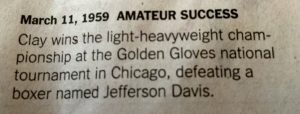
Please sign the petition below to remove the statue of Jefferson Davis currently in Kentucky’s Capitol Rotunda, and replace it with a tribute to Muhammad Ali, “the Louisville Lip” and “the Greatest of All Time.”
I just heard from the Ali family: It is the Champ’s belief that Islam prohibits three-dimensional representations of living Muslims. Accordingly, I have adjusted the petition to call for a two-dimensional representation of Ali (a portrait, picture or mural) in lieu of a statue.
UPDATE (Tuesday, December 2, 2014)
In this interview with WHAS-TV’s Joe Arnold, Governor Steve Beshear endorses the idea of honoring Muhammad Ali in the State Capitol (although he disagrees with removing Davis). Arnold explores the idea further on his weekly show, “The Powers that Be.”
Click here to check out WDRB-TV’s Lawrence Smith’s coverage of the story.
And here’s my op-ed in Ali’s hometown paper, the Louisville Courier-Journal.
UPDATE (Saturday, June 4, 2016)
In the wake of the 2015 Charlestown tragedy, in which a Confederate flag-waving murderer united the nation against racism, all of the most powerful Kentucky policymakers — U.S. Senator Mitch McConnell, Governor Matt Bevin, Senate President Robert Stivers and House Speaker Greg Stumbo — called for the removal of the Davis statue from the Rotunda. Today, as we commemorate last night’s passing of Muhammad Ali, there is no better moment to replace the symbol of Kentucky’s worst era with a tribute to The Greatest of All Time.
UPDATE (Wednesday, June 8, 2016):
Great piece by Lawrence Smith of WDRB-TV in Louisville on the petition drive to replace Jefferson Davis’ statue in the Capitol Rotunda with a tribute to Muhammad Ali.
UPDATE (Thursday, June 9, 2016):
Excellent piece on the petition drive by Jack Brammer that was featured on the front page of the Lexington Herald-Leader.
Highlight of the article:
Miller said he has received a few “angry comments” on his call to honor Ali.
“One of them encouraged me to kill myself,” he said. “You can quote me that I have decided not to take their advice.”
UPDATE (Friday, June 10, 2016)
The petition drives continues to show the Big Mo(hammed): check out these stories from WKYU-FM public radio in Bowling Green and WKYT-TV, Channel 27 in Lexington:
UPDATE (Saturday, June 11, 2016):
Still not convinced? Check out this excerpt from today’s New York Times:
In case you were battling the heat and rain of Kentucky’s Fancy Farm political festivities — or more appropriately, were enjoying some quality time with your family — you may have missed the RP’s latest column that The Huffington Post touted on its home page all weekend.
Having received positive feedback — and considerablemediaattention — from his piece two weeks ago,”Debt Ceiling for Dummies,” the RP penned a column to help explain in similarly straight-forward terms the import of Friday night’s decision by S&P to downgrade U.S. credit.
Why should we listen to the credit agencies — aren’t they part of the problem?
There is broad consensus that credit rating agency action — or often times, inaction — was a significant contributor to the 2008 financial collapse. This April, a U.S. Senate investigations panel declared that Moody’s and S&P triggered the financial crisis when they were forced to downgrade their ratings on the very complex and controversial mortgage-backed securities that were at the heart of the collapse that almost brought our entire financial system to its knees. Had the ratings agencies been exercising more diligence, many experts argue, they would have alerted investors of the riskiness of these controversial financial instruments long before they became a problem.
However, while the credit ratings agencies do not enter the discussion with entirely clean hands, their decisions are extraordinary significant. Their role is written into the statutes and regulations that govern the financial system. Think of it this way: Even though progressives may decry the partisanship on the U.S. Supreme Court, and thoroughly detest some of its recent 5-4 decisions, we must abide by them.
By Jonathan Miller, on Sat Aug 6, 2011 at 2:30 PM ET
Having received positive feedback — and considerablemediaattention — from my piece two weeks ago that explained the sometimes esoteric, often confusing subject matter surrounding the debt crisis debate (“Debt Ceiling for Dummies“), I decided today to pen a quick column to help explain in similarly straight-forward terms the import of last night’s decision by S&P to downgrade U.S. credit.
Who are the credit rating agencies and what did they just do?
There are three primary national credit rating agencies: Fitch, Moody’s Investors Service (“Moody’s”), and Standard and Poor’s (“S&P”). These agencies rate the creditworthiness of governments, companies and individual securities, allowing investors to better understand the risk of their investments. The higher the rating, the more creditworthy — or, alternatively, the less risky — the investment.
Our federal government is one of the many entities these agencies rate. The U.S. borrows money — by issuing bonds and Treasury bills to governments, corporations and individual investors — in order to operate all of its essential functions. The outstanding current federal debt currently exceeds $14.5 trillion.
Since the credit rating agencies were established, U.S. Treasuries have always enjoyed a triple A rating, the very highest: indicating to global financial markets that they are among the safest investment instruments in the world. Friday night, however — for the first time in the nation’s history — S&P downgraded the rating of the nation’s long-term debt to AA+, one notch below AAA, meaning that the U.S. has been removed from its list of risk-free borrowers.
Earlier in the week, Moody’s and Fitch both declined to downgrade the country’s credit rating. Moody’s, however, changed its “outlook” on U.S. debt to “negative,” meaning that there is a risk of a future downgrade. Fitch stated it would determine whether to lower its own outlook by the end of the month. Both have urged Congress to make more progress in debt reduction in order to avoid a potential full downgrade.
By Stephanie Doctrow, RP Staff, on Fri Aug 5, 2011 at 12:00 PM ET
The newest group targeted to join Facebook: fetuses. “Expected: Child” is now an option on the social networking site for proud parents-to-be. [Time]
Celebrity spokespeople for weight loss regimens can inspire others to be healthy… but how does the pressure of being in the limelight affect them? [NY Times]
Tropical Storm Emily is headed is headed straight towards Haiti. How will the nation fare against another storm, as its cholera outbreak gets worse? [Fox News]
Attention, new parents! According to a new study, when infants are exposed to mold in their home their risk for asthma more than doubles. [CNN]
Contributing RP Rod Jetton has launched his own blog to comment on Missouri politics. Here is his first entry:
There was a lot of talk about tax credits in the last legislative session. I would like to recommend one tax credit that would only cost a maximum of 2 million per a year, but will help thousands of Missourians get enough to eat. It’s the Local Food Pantry Tax Credit Program (LFPTCP) that was started in 2008 and is scheduled to expire in 2012.
The Oversight Division of the Joint Committee on Legislative Research issued a report showing that the first three years of the four-year program, only $1.5 million of the $6 million available credits were claimed, but use has grown significantly each year, with nearly $800,000 claimed in 2010. The average donation was $450 with 99 percent of the statewide credits being claimed by individual taxpayers.
While the battle rages in Jefferson City about how to reform our tax credit programs. This program already includes many of the reforms that have been debated. Most tax credit reformers have four main goals, which include:
1. Cap the amount of tax credits one individual can receive
2. Keep tax credits from being sold or transferred
3. Cap the overall amount that can be spent on any one program.
4. Sunset all tax credit program
Most reform advocates believe these changes will make budgeting for future tax credit expenditures more accurate. They also feel it will allow the programs to be better monitored, so that needed changes can be made.
By Zack Adams, RP Staff, on Thu Aug 4, 2011 at 3:00 PM ET
The Politics of Speed
Hyundai and Kia, the two largest South Korean automakers, gained more market share in the US from 2010 to 2011 than any other company. Additionally, their combined jump helped them overtake all European automakers combined. I agree with the article that the biggest reason for the jump in sales is simply that Hyundai and Kia are building cars that Americans want to buy. In the end, that is what it all comes down to. [Jalopnik]
A proposed law in Illinois would allow motorcyclists to treat red stoplights as stop signs. This has stemmed from complaints from motorcycle riders that their smaller vehicles often fail to trigger red lights to turn green. I’ll keep an eye on this and we’ll see if it passes. [Daily Herald]
Here is an article about the realization that the Formula 1 broadcast team on the SPEED channel does a much better job than the regular NASCAR crew. I haven’t listened to enough F1 broadcasts to weigh in on the matter. However, when the author mentions how the NASCAR crew often feels a need to be a part of the story instead of simply presenting it, I know where he is coming from. In my opinion, any analyst/commentator should focus first on presenting the event they are covering in an effective manner and worry about the fluff after. [All Left Turns]
From Noon EDT to 1:00 PM EDT, the RP will be talking the debt ceiling and No Labels on Jefferson Public Radio, which covers Oregon and Northern California.



 Blog this!