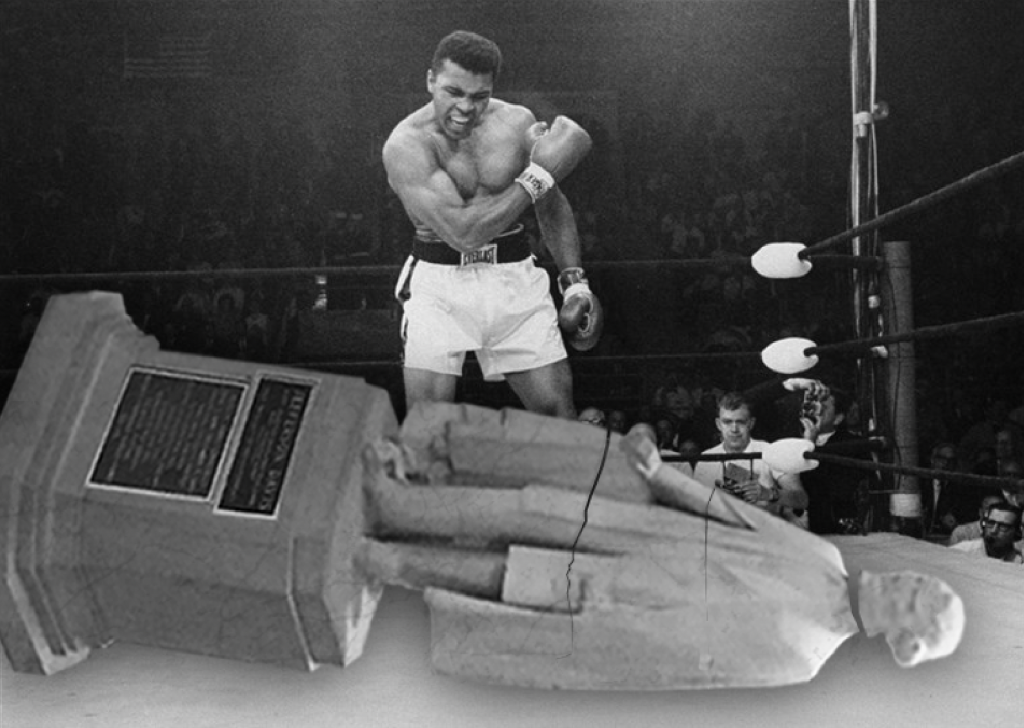
Please sign the petition below to remove the statue of Jefferson Davis currently in Kentucky’s Capitol Rotunda, and replace it with a tribute to Muhammad Ali, “the Louisville Lip” and “the Greatest of All Time.”
I just heard from the Ali family: It is the Champ’s belief that Islam prohibits three-dimensional representations of living Muslims. Accordingly, I have adjusted the petition to call for a two-dimensional representation of Ali (a portrait, picture or mural) in lieu of a statue.
UPDATE (Tuesday, December 2, 2014)
In this interview with WHAS-TV’s Joe Arnold, Governor Steve Beshear endorses the idea of honoring Muhammad Ali in the State Capitol (although he disagrees with removing Davis). Arnold explores the idea further on his weekly show, “The Powers that Be.”
Click here to check out WDRB-TV’s Lawrence Smith’s coverage of the story.
And here’s my op-ed in Ali’s hometown paper, the Louisville Courier-Journal.
UPDATE (Saturday, June 4, 2016)
In the wake of the 2015 Charlestown tragedy, in which a Confederate flag-waving murderer united the nation against racism, all of the most powerful Kentucky policymakers — U.S. Senator Mitch McConnell, Governor Matt Bevin, Senate President Robert Stivers and House Speaker Greg Stumbo — called for the removal of the Davis statue from the Rotunda. Today, as we commemorate last night’s passing of Muhammad Ali, there is no better moment to replace the symbol of Kentucky’s worst era with a tribute to The Greatest of All Time.
UPDATE (Wednesday, June 8, 2016):
Great piece by Lawrence Smith of WDRB-TV in Louisville on the petition drive to replace Jefferson Davis’ statue in the Capitol Rotunda with a tribute to Muhammad Ali.
UPDATE (Thursday, June 9, 2016):
Excellent piece on the petition drive by Jack Brammer that was featured on the front page of the Lexington Herald-Leader.
Highlight of the article:
Miller said he has received a few “angry comments” on his call to honor Ali.
“One of them encouraged me to kill myself,” he said. “You can quote me that I have decided not to take their advice.”
UPDATE (Friday, June 10, 2016)
The petition drives continues to show the Big Mo(hammed): check out these stories from WKYU-FM public radio in Bowling Green and WKYT-TV, Channel 27 in Lexington:
UPDATE (Saturday, June 11, 2016):
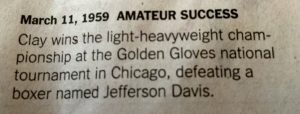
Still not convinced? Check out this excerpt from today’s New York Times:
Yesterday, The Recovering Politician featured a lively debate among the contributing RPs on the subject of whether states should expand gambling for the additional tax revenues they present during these difficult times.
To review all of the arguments and counter-arguments, pro, con and sideways, from yesterday’s RPs Debate, click here.
Our readers sent in some very thoughtful and interesting comments. We excerpt a few below:
I understand the need for gambling in Kentucky. I have no moral arguments against gambling. My discussion is more the benefits of the individual vs. the benefits of society. First a disclaimer – I’m very liberal. Statistically speaking, it is no surprise to the educated that gambling favors the “house”. The odds are any one person will probably lose more money than they gain from a wager.
According to a national survey, blacks and Hispanics are more likely to be “pathological” gamblers. Impulsivity also was greater among youth of lower socio-economic status . Gambling can also find risk populations with older adults. The bottom line, to me, is does the benefit of society outweigh the benefit (or lack thereof) for the individual. W.C. Fields said there’s a sucker born every minute. And Kentucky would depend on these “suckers” to help fund our state. Yes, we have our signs that urge citizens to drink responsibly, gamble responsibly, etc. But I can’t help but feel Kentucky would be enabling a negative behavior for those least able to afford it.
I understand other states have gambling, and Kentucky is losing $$ to those states. What percentage of Kentucky citizens are flocking to tangential states, and what percentage do we anticipate gambling would increase in Kentucky with in-state casinos? We need to be creative to generate income for our state. And I know in-state gambling is one of those creative ideas. I just believe it is an idea the ultimately will generate as many problems as it attempts to solve.
Read the rest of… The RP Nation Weighs in on the Gambling Debate
I’m going to resist the urge to rebut David Host’s full-throated defense of trickle-down economics — we will leave that for another day.
I’ll close instead on a harmonizing note. Too often the two sides of the gambling debate are boiled down to self-righteous moralists versus selfish libertarians. (Indeed, more often the media focuses on the politics rather than the underlying policy debate.) In fact, whether we are discussing casinos, sports betting, or even a state lottery, there are valuable and valued moral arguments on each side of the issue.
Read the rest of… The RPs Debate Gambling: The RP’s Closing Argument
Given that Kentucky’s self-image is significantly rooted in an industry built upon parimutuel betting, opposing legalized gambling on moral grounds alone seems to require some degree of cognitive dissonance. Moreover, the Kentucky Lottery is now more than two decades old – meaning that the camel (horse?) poked its nose under the tent some time ago.
Nevertheless, I do sympathize with those who wish to draw some practical line; who sense something amiss when state governments rush to endorse an industry which destroys lives. Perhaps a reasonable case exists for allowing thoroughbred tracks to expand into slots and other gaming at existing locations; such a measure is a far cry from actively promoting the expansion of gaming as a remedy for budget shortfalls.
Certainly, expanded gaming offers an appealing short-term means for shoring up cash-strapped government budgets; perhaps a necessary evil in service of the long-term public good. Yet, the risk in embracing gambling as an interim solution remains its potential to become a permanent substitute for fundamental reform.
I respectfully disagree with Jonathan’s premise that we cannot “balance our government’s books and invest in our country’s future without either raising taxes or reforming entitlement spending.”
I would add just a little to Jonathan’s arguments against sports gambling, which I think are entirely correct. The NCAA struggles to police the rules that exist today; it is a notoriously weak investigator without subpoena power, and I cant’t imagine the strains it would face if policing the ties between amateurs and more powerful, more nationalized gambling interests were part of it’s charter.
It’s worth examining the question of why the current regime of legalized sports betting in a few jurisdictions doesn’t pose the same risks. In fairness to Jason Grill’s case, there are enormous sums of gambling money at work today, and it’s been over 25 years since there was a bona-fide betting scandal in college sports. The true answer is that we don’t know what changing the scale of sports betting would do to incentivize corruption; in my mind, however, that’s a strike in it’s own right. If we guess wrong, the likelihood is an irreparable stain on amateur athletics. It’s also likely that, as I have argued in the context of legalizing marijuana, criminals are far more likely to bend their business model to profit from looser regulations, than they are to forfeit a lucrative market altogether.
Read the rest of… The RPs Debate Gambling: Artur Davis Responds
The FBI estimates that more than $2.5 billion is illegally wagered annually on the NCAA basketball tournament each year. However, Nevada sportsbook operators estimate close to $90 million or less than 4 percent of illegal betting on March Madness is wagered legally on the tournament in their state.
Read the rest of… The RPs Debate Gambling: Jason Grill Responds
I guess it’s fitting that the guy who opened up this can of worms will be the first to try to shut it a bit.
I’m agnostic about Jason’s idea when it is applied to professional sports. I think players are paid too much these days for the threat of Black Sox-era thrown ballgames return. Pete Rose’s stupidity is the modern exception; when most professional players cheat today, it is in reference to the substances they ingest or inject, not the influence of gamblers and loan sharks.
My problem with Jason’s argument is how it applies to college athletics. I’ve written at this site — and more recently both Taylor Branch and Joe Nocera have written brilliant searing, substantive essays — about corruption in college sports, particularly of the extraordinary unfairness towards the unpaid athletes who are earning universities and their coaches millions of dollars.
Read the rest of… The RPs Debate Gambling: The RP Defends
Given the RP Debate two weeks ago on legalizing marijuana, Jeff Smith advises the RP Nation to check out an excellent piece from this week’s The New Yorker: “Mass Incarceration and Criminal Justice in America”
A prison is a trap for catching time. Good reporting appears often about the inner life of the American prison, but the catch is that American prison life is mostly undramatic—the reported stories fail to grab us, because, for the most part, nothing happens. One day in the life of Ivan Denisovich is all you need to know about Ivan Denisovich, because the idea that anyone could live for a minute in such circumstances seems impossible; one day in the life of an American prison means much less, because the force of it is that one day typically stretches out for decades. It isn’t the horror of the time at hand but the unimaginable sameness of the time ahead that makes prisons unendurable for their inmates. The inmates on death row in Texas are called men in “timeless time,” because they alone aren’t serving time: they aren’t waiting out five years or a decade or a lifetime. The basic reality of American prisons is not that of the lock and key but that of the lock and clock.
That’s why no one who has been inside a prison, if only for a day, can ever forget the feeling. Time stops. A note of attenuated panic, of watchful paranoia—anxiety and boredom and fear mixed into a kind of enveloping fog, covering the guards as much as the guarded. “Sometimes I think this whole world is one big prison yard, / Some of us are prisoners, some of us are guards,” Dylan sings, and while it isn’t strictly true—just ask the prisoners—it contains a truth: the guards are doing time, too. As a smart man once wrote after being locked up, the thing about jail is that there are bars on the windows and they won’t let you out. This simple truth governs all the others. What prisoners try to convey to the free is how the presence of time as something being done to you, instead of something you do things with, alters the mind at every moment. For American prisoners, huge numbers of whom are serving sentences much longer than those given for similar crimes anywhere else in the civilized world—Texas alone has sentenced more than four hundred teen-agers to life imprisonment—time becomes in every sense this thing you serve.
By John Y. Brown III, on Mon Jan 30, 2012 at 12:00 PM ET
Know your strengths and your calling.
Just as importantly, know your weaknesses and limitations. For your sake —and because it’s the right thing. And because it works out best for all concerned.
Nine years ago I was entering my last year as secretary of state (term limited) and planning to run next for state auditor. It was the next logical step for me politically, no one else had filed on the democratic side and the filing deadline was approaching.
But there was a problem. I didn’t want to be state auditor.
It wasn’t an intellectual resistance. It was a gut feeling that it wasn’t a good fit for me….that I would have a hard time putting my heart into the job. I liked to build things and wasn’t a natural investigator. And accounting was never my strong suit.
Mostly, though, I didn’t want to run for political office just to stay in the game. I had watched other politicians run for office when they didn’t have their heart in it. And despite being favorites to win, they seemed always to lose.
Why? I think voters sensed they didn’t have the “fire in their belly” and that the office they were seeking was more of a place holder for something better in the future. I told myself I would never let that happen to me. But now I was faced with the ultimate test.
What would I do?
Read the rest of… John Y’s Musings from the Middle: Know Your Calling
Lets change the direction of this debate a little bit.
It’s all about sports gambling ladies and gentlemen.
As a member of the Missouri House of Representatives, I sponsored a resolution calling on Congress to repeal the Federal Professional And Amateur Sports Promotion Act of 1992 (PASPA). The 1992 law prohibited all but four states from offering sports gambling. The four states exempted from this act were Delaware, Montana, Nevada, and Oregon.
Missouri currently allows twelve gambling casinos in the State. They should have the option to put a sportsbook in each one of them. The federal law is outdated and is truly discriminatory towards 46 other states. These states should have the option to share in the major economic and revenue benefits that sports betting can provide.
Guess what…The Super Bowl is this week. Lets take a look at a few stats…
Read the rest of… The RPs Debate Gambling: Jason Grill Rebuts


 Blog this!