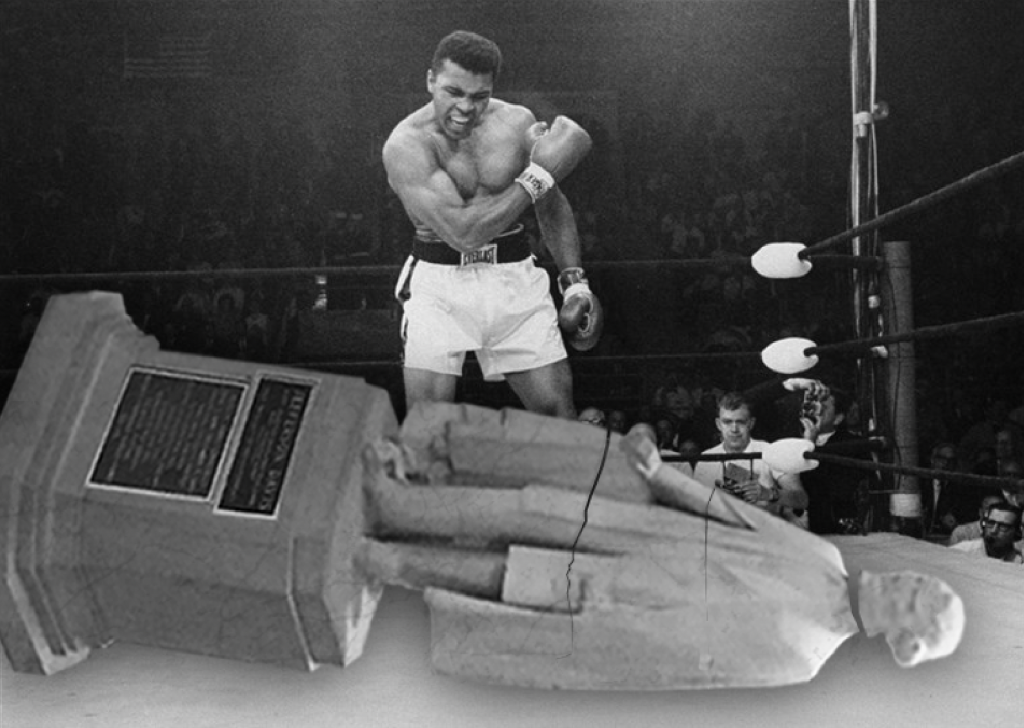
Please sign the petition below to remove the statue of Jefferson Davis currently in Kentucky’s Capitol Rotunda, and replace it with a tribute to Muhammad Ali, “the Louisville Lip” and “the Greatest of All Time.”
I just heard from the Ali family: It is the Champ’s belief that Islam prohibits three-dimensional representations of living Muslims. Accordingly, I have adjusted the petition to call for a two-dimensional representation of Ali (a portrait, picture or mural) in lieu of a statue.
UPDATE (Tuesday, December 2, 2014)
In this interview with WHAS-TV’s Joe Arnold, Governor Steve Beshear endorses the idea of honoring Muhammad Ali in the State Capitol (although he disagrees with removing Davis). Arnold explores the idea further on his weekly show, “The Powers that Be.”
Click here to check out WDRB-TV’s Lawrence Smith’s coverage of the story.
And here’s my op-ed in Ali’s hometown paper, the Louisville Courier-Journal.
UPDATE (Saturday, June 4, 2016)
In the wake of the 2015 Charlestown tragedy, in which a Confederate flag-waving murderer united the nation against racism, all of the most powerful Kentucky policymakers — U.S. Senator Mitch McConnell, Governor Matt Bevin, Senate President Robert Stivers and House Speaker Greg Stumbo — called for the removal of the Davis statue from the Rotunda. Today, as we commemorate last night’s passing of Muhammad Ali, there is no better moment to replace the symbol of Kentucky’s worst era with a tribute to The Greatest of All Time.
UPDATE (Wednesday, June 8, 2016):
Great piece by Lawrence Smith of WDRB-TV in Louisville on the petition drive to replace Jefferson Davis’ statue in the Capitol Rotunda with a tribute to Muhammad Ali.
UPDATE (Thursday, June 9, 2016):
Excellent piece on the petition drive by Jack Brammer that was featured on the front page of the Lexington Herald-Leader.
Highlight of the article:
Miller said he has received a few “angry comments” on his call to honor Ali.
“One of them encouraged me to kill myself,” he said. “You can quote me that I have decided not to take their advice.”
UPDATE (Friday, June 10, 2016)
The petition drives continues to show the Big Mo(hammed): check out these stories from WKYU-FM public radio in Bowling Green and WKYT-TV, Channel 27 in Lexington:
UPDATE (Saturday, June 11, 2016):
Still not convinced? Check out this excerpt from today’s New York Times:
By Artur Davis, on Tue Sep 24, 2013 at 10:00 AM ET
Molly Redden’s essay in the New Republic about the waning of Democratic centrists may be off-base in its examples—Christine Quinn’s deficiencies as a candidate competed with her ideological positioning as a source of her troubles, and Bill Daley’s withdrawal from the Illinois Governors’ race can hardly be attributed to a leftist backlash when he was running ahead in the polls—but her premise is certainly not one an expatriate former Democrat like myself would argue. In fact, I will use her observations to go one step further: the declining appeal of centrism in Democratic politics is not only tactically relevant to candidates, it is about to become just as culpable from a policy shaping standpoint as the much more heralded implosion of the old governing “establishment” wing of the Republican Party.
To be sure, Redden and her like-minded colleague Noam Scheiber aren’t spending much anxiety on the erosion of Democratic social conservatism, but they are highlighting that essentially one economic world view is tenable within internal Democratic fights. The tenets are that the inequitable distribution of wealth is the dominant economic threat; an aggressively regulated marketplace promotes fairness in a manner that overshadows any costs to innovation or growth; and the only adequate response to more systemic conditions like high unemployment and poverty is an assertive infusion of public dollars. In practical campaign terms, this means a candidate with a record of alliances with corporate institutions will need to spend time disgorging any rhetoric that helped forge those ties (for example, the Cory Booker who 16 months ago was defending private equity’s capacity to invest in underserved neighborhoods has morphed into the soon to be senator whose stump speech laments the failure to hand down prison sentences to Lehman executives); and a Bill de Blasio will have a built-in advantage over a more pro growth oriented message even without the special circumstances of identity politics around his mayoral nomination in New York City.
But the demise of the corporatist sensibility in Democratic politics has arguably spilled into an aversion to the reform minded brand of politics that was until recently an underpinning of both the party’s strategic and policy framework. This plays out most decisively in the context of entitlements. There is a near universal consensus among Democratic politicians and elites that the current entitlement structure is morally and fiscally sound enough that a genuine overhaul is neither desirable nor necessary: a sharp movement from the Simpson Bowles approach a notable number of Democratic thought leaders praised in 2011 and a lifetime of difference from some of the thought experiments of the late Clinton era.
The same antipathy to reform surfaces in the disappearance of the old Robert Kennedy critique of bureaucratic anti-poverty institutions, and in the field of education reform, where accountability and strengthened teacher standards are about as unpopular among today’s Democrats as vouchers or parental choice; that is to say, almost toxic. And, as fellow right-leaning reformers like Reihan Salam and Ross Douthat might point out, there is no meaningful discussion in contemporary liberalism of the kind of pro family tax reform that would advantage major portions of the Democratic Party’s low wage base; and it is conservative pundits who are churning out proposals to make the earned income tax credit more flexible or to permanently reduce FICA taxation on the working poor.
Read the rest of… Artur Davis: Those Fading Democratic Centrists
By Nancy Slotnick, on Tue Sep 24, 2013 at 8:30 AM ET
“There’s only one thing that he’s got that you haven’t got—courage.”—The Wizard of Oz to the lion.
A brain, a heart—to most of us, those aren’t that hard to muster. Or I should revise- for the people that interest me the most, brains and heart aren’t hard to muster. By the time of our grown-up life, we probably have honed our brains to be smart (is that possible? Sounds painful.) And either we have heart by now or we don’t. And in my opinion you gotta have heart. And if you don’t, well then, you won’t be going to see the musical Damn Yankees. And that’s ok because it hasn’t been on Broadway since circa 1997. But I digress.
Courage is hard for all of us. At least for me, courage is the hardest of the wizardly gifts. Perhaps because it’s unsteady. I have had a lot of courage at various moments in my life, but I still find it hard each time. The challenges that used to require courage get easier, but the sinking feeling in my stomach when I face a new challenge hasn’t gone away. Somehow I’m still able to put cheese fries in my stomach. But that may be a form of denial.
Case in point– Barbra Streisand gets stage fright to this day. So what to do when we have to face fears anyway? I dare myself. Then I set my dare to music. This week my theme song is Bust a Move. “If you want it. You got it.” I took a look at the lyrics. Seems like it’s talking to a kid who probably looks like a fat Urkel from Family Matters but apparently he can dance when it all comes down to it.
We all feel like Urkel on the inside. Especially when it comes to dating. I know I did. And still do, just I’m not in the dating pool anymore, thankfully. In ’96, I named my dating-café “Drip” because everyone feels like a drip when they’re dating. Even the café itself would have felt like a drip if I had named it the “Lonely Hearts Café” or something like that.
By Erica and Matt Chua, on Mon Sep 23, 2013 at 1:30 PM ET
For every story on LivingIF, there is a backstory. Here are two unforgettable experiences we had due to Couchsurfing, both of which led to trip highlights. Let us know in the comments if there are any stories you’ve read here that you wanted to know more about how they happened…
HE SAID…
I wonder what our trip would have been without Couchsurfing. Staying with strangers, all around the world, was one of the most memorable experiences of the trip. The problem with Couchsurfing though is that it is a logistical challenge. Instead of heading to a central area to find a hotel, you have to head to residential areas, then find a person. Arriving in a new country, without a phone, trying to find someone inevitably leads to memorable situations. Nothing was quite like getting from Japan to South Korea.
Getting to South Korea meant exiting Japan, leaving Japan meant a last night out on the town that went from bar to bar to karaoke to sunrise. Taking a quick nap we had some takeout sushi for breakfast and headed to Tokyo’s Narita Airport. Narita is a city about an hour away from Tokyo, so we gave ourselves plenty of time, and casually switched trains from the metro to the suburban rail lines. Simple enough, just go to Narita, right? WRONG, never go to Narita…go to Narita Airport! They are very different destinations.
Arriving in Narita we realized our mistake and had burned our extra time. We ran out of the train station and asked a taxi driver how much to get to the airport. Translating on his phone he estimated it would be $120 and take over an hour…he recommended we take the train. Running back into the station, I saw a person who looked about 18 and asked him, “do you have an iPhone?” He responded, “hai” and handed it to me. Think about this for a second, on a train platform he just handed a complete stranger his iPhone…that’s Japan for you.
The man with the iPhone said that he too was going to the airport…and he’d take us to the check-in counters. Looking at the train schedule, he estimated we’d arrive at the airport 25 minutes before our flight’s departure. He studied the Narita airport map from the train to the Delta check-in counter so we wouldn’t make a wrong turn. The three of us burst through the still-opening doors of the train, LOCAVORista and him sprinting to the counters with me behind carrying our bags. The check-in staff made a few calls to allow us to check-in, 15 minutes from an international departure, and instructed us, “you go now!” We said goodbye to our new Japanese friend and rushed through security, immigration and the terminal. We got to the gate and found everyone still at the gate; the flight had a last-minute delay of 30 minutes!
Read the rest of… Matt and Erica Chua: He Said/She Said: Behind the Blog Couchsurfing
By John Y. Brown III, on Mon Sep 23, 2013 at 12:00 PM ET
I wonder if Stick People know that other people think of them as Stick People?Even if they do know they don’t seem to be bothered by it.
I wish I could be more like Stick People in that way.
===
When life gives us lemons, try responding “Wow! Free lemons! How cool is that?”And then start a lemonade business.
===
We are not our woundsWe are not even the story we tell ourselves and others about our wounds.
We are whatever we do to overcome our wounds. That, it seems to me, is what ultimately defines us most.
===
Do we parents really raise our children.
Or do they secretly really raise us?
Some days I feel like Rod Serling will step out from the next room and start explaining this entire hoax — that all along our children have patiently and lovingly been guiding us into adulthood. And as the youngest approaches age 18, facing the horrifying feeling that you are not ready for her to leave because you are not yet fully an adult.
In response to The RP’s controversial piece published in The Daily Beast this weekend, advocating for an end to Big Sport’s War on Steroids, Reid Mann offered to the discussion his 2010 law school treatise on the steroid scare. Here’s an excerpt:
In 1990 the US Congress passed the Anabolic Steroids Control Act which effectively placed steroids as a schedule III controlled substance. The events leading up to, as well as thoseincluded in the passage of this legislation, suggest a Congressional purpose void of rationality.As a result of the legislation steroids have been criminalized and extremely harsh penalties have been established for those who illegally poses or use steroids. This paper argues that (1) By enacting this law Congress has acted irrationally and arbitrarily and thus the legislation fails the rational bases standard; (2) Congress circumvented an established administrative drug process resulting in bad law and poor public policy; and (3) there are more effective and rational methodsto achieve Congress’s purposes of regulating anabolic steroids. The first part of this paper willdiscuss a brief history of steroids, their pharmacology, and the legislative history leading up totheir criminalization in 1990. The second part will identify why current steroids laws areirrational and arbitrary. The third part will discuss public policy issues, and lastly address better means for regulating steroids.
By Jonathan Miller, on Mon Sep 23, 2013 at 10:00 AM ET
In his latest column for The Daily Beast, The RP takes a controversial position on Big Sport’s War on Steroids — he claims that anti-PED hysteria is misplaced, hypocritical and completely ineffective. And his viewpoint is very personal. Read an excerpt:
I’m coming clean: I use performance enhancing drugs.
Indeed, I’ve had a serious testosterone problem.
Of course, unlike my fellow Jewish recovering politicians (ahem…Mssrs. Spitzer, Weiner and Filner), my body doesn’t produce enough of the über-manly hormone. A few years ago, I was diagnosed with a free testosterone level akin to an octogenarian eunuch. Who’d been dead for a decade.
The option of traditional testosterone therapy, however, frankly frightened me. I’d heard the woeful tales of back acne, hair in strange places, ‘roid rage, the link to prostate cancer. I also remember vividly football superstar Lyle Alzado‘s final days, blaming his brutal death from brain cancer on PED overuse. And as an ESPN Radio addict, I’d been bombarded for years by its omnipresent, perversely mixed messages: the screaming sports host anti-steroid hysteria, interrupted every twenty minutes by snake-oily “Low T” elixir ads, using the kind of incredulous performance hype that would discomfit even Bernie Madoff.
So I tried an alternative route — medically-sanctioned natural vitamins and minerals, prescribed by a well-respected M.D., whose practice focused on integrative health.
Nothing. And I was suffering.
While our sex-obsessed culture focuses on the libido-suppressing side effects of a “Low T” diagnosis, the ramifications for me were quite more significant. My immune system was shot; my body had become a petri dish for every new virus of the week. Worse, my mood and energy levels had plummeted: Despite enjoying perhaps the happiest and most successful years of my life, there were far too many mornings when I struggled simply to get out of bed.
By Jonathan Miller, on Mon Sep 23, 2013 at 9:15 AM ET
Our very own personal fitness advisor, Josh Bowen, is getting some big press for being named one of the ten top personal trainers in the world.
Check out an excerpt from today’s story in the Lexington Herald-Leader:
After 10 years in the business, personal trainer Josh Bowen is accustomed to meeting strangers and tailoring a fitness program to their goals.
But his comfort zone will be challenged this week in England, where he’ll be competing in a contest that will judge his abilities.
Bowen is a finalist in the Life Fitness Personal Trainers to Watch competition, which will be Friday in London. Ten personal trainers will be judged on their abilities to motivate, praise and collaborate with a client. The winner receives $5,000 and bragging rights.
Some 1,500 applicants from 43 countries applied to take part in the competition.
Bowen, 31, said that when potential customers approach him, “I have to quickly try to make a relationship with them, draw out their goals and nutrition, and then I show them what I do. I’m used to doing that on the fly — that doesn’t intimidate me at all — but I really don’t know what to expect (in London). I don’t know who I’m going to be training.”
Nevertheless, Bowen said, he is confident and ready.
“If there’s anything I’m going to compete in, this would be it. That’s not to say I’m going in cocky, but I have a confidence about myself,” he said.
…
Another fan of Bowen is former state treasurer Jonathan Miller, whose Recovering Politician publishing company will print Bowen’s book, The 12 Steps to Fitness Freedom, in January.
“There are 12 steps every body needs to get results from fitness,” Bowen said. “It goes through all the things I would go through with a client. I can touch more people that way.”
Bowen has been Miller’s personal trainer for years and has helped Miller with “middle-age maladies” like lower back pain.
“He really has a holistic approach to personal training,” Miller said. “It’s not just going to the gym to lift weights. (In the book) he’s able to combine all those things into something the average reader can grasp.”
Calling all innovators and designers. It is time to get below the buzzwords and to mobilize our networks with urgency and purpose. Waiting for public and private sector institutions to transform our urban economies won’t work. It is up to us to deliver on the promise of social media platforms and self-organizing networks. We must mobilize purposeful networks to address the big social challenges of our time including education, economic, and workforce development. I got a big wake up call last week while visiting Detroit for the first time. Talk about a burning platform. If you need a call to action just visit Detroit and see the devastation for yourself.
This once great industrial city is a shell of its former self. Detroit has lost half of its population going from a peak in the 1950′s of 2 million to under 1 million in the 2000 census. It is expected that the population will settle below 700,000 as unemployment and home foreclosures continue to fuel out-migration. What is to become of those that can’t get out and are left behind?
Real unemployment rates in Detroit are thought to be as high as 50% and recent block-by-block surveys indicate that about one in three land parcels are either vacant or abandoned. Arne Duncan, Secretary of Education, called Detroit Public Schools a national disgrace that keeps him up at night. The new Mayor, Dave Bing, is talking about downsizing the city including drastic plans to relocate residents from desolate to stable neighborhoods.
You get the picture. It is enough to make you cry. Detroit isn’t the only urban center that has been devastated by the departure of an industrial era along with its good manufacturing jobs. Is your city far behind Detroit? The need for bold moves and real systems change seems so obvious. We can’t possibly address these challenges with tweaks to our current economic, education, and workforce development systems.
I went to Detroit to participate in a conversation about changing the trajectory of our urban economies. I had high expectations but the well-intentioned leaders assembled seemed resigned to working within current economic development models and systems to change our urban outcomes. I guess I naively expected more outrage and a greater sense of urgency for bold action to change the trajectory.
By Jason Atkinson, on Fri Sep 20, 2013 at 1:31 PM ET
Conservation in America is shifting to the “radical middle.” The extreme edges of the political spectrum, right and left, the partisans, protect the status quo. That has radicalized those caught in middle, where most Americans live, where people and their local environments suffer the consequences of partisan gridlock. People want and need action, not obstruction.
A perfect example of the radical middle is Long Island’s Great South Bay. A true grassroots movement from towns like — Babylon, Sayville, Bellport, Patchogue and a dozen others — want their bay back. For centuries, this bay produced oysters, finfish, and clams, providing livelihoods to thousands of families. Today, that world is all but gone, destroyed by over-harvesting, rampant over-development, along with the gross mismanagement of the bay and of Fire Island, the barrier beach forming the bay’s southern border. A laissez-faire approach to resource management led to a ‘tragedy of the commons.’
Until now, the issues faced by Long Island’s shorelines and Fire Island were addressed ‘top-down,’ with The Army Corps of Engineers literally drawing lines in the sand. When a storm washed away dunes on Fire Island, or breached the barrier, the solution was simple: pile more sand. Billions spent over the decades to defend the indefensible, with the baymen knowing all along their bay needed regular flushing the breaches and shifting sands provided. The bay needs clean ocean water to come in an out with the tide, regardless of who is in office. But money can move faster than sand, and after all, there were were summer homes with basements to protect. The Army Corps, like America itself, has been informed by the old rules of conservation, where man can supposedly bend nature to our will and still protect it.
With Sandy, however, came “The Breach,” a place on Fire Island’s National Seashore where the ocean broke through to the bay where The Army Corps of Engineers had limited jurisdiction. They couldn’t, post-Sandy, go and fill it in as they had with two other breaches. Within weeks, locals began to see years of stagnation convert into clear water. Fish returned, clam growth accelerated, eelgrass started sprouting. Residents of the South Shore could see their past again — and just maybe their future. They rallied fiercely to defend the breach against Democrats like Senator Schumer and Steve Bellone, the Suffolk County Executive, who sought its immediate closure, for reasons having nothing to do with science and everything to do with politics.
Buried on Long Island are an estimated 500,000 septic tanks seeping into its sandy soil and triggering brown tides, rust tides, red tides, and blue green algae, wiping out Long Island’s bays, rivers and ponds. The Brookhaven town dump, referred to locally as “Mt. Trashmore,” the only mountain seen from the bay, leach downhill into the water, too. Mainline conservationists have failed to convey to the larger public they have come to the point where Long Island is at the brink of an ecological collapse.
The radical middle knows the problems we face are fixable, building clean bays and protecting our waters is not rocket surgery. The old way of thinking is that all environmental issues are organized vertically, mainly in one party. My friends on the extreme right would say ‘this is all an environmental conspiracy,’ whereas our supposed Democratic stewards have typically funneled money into the hands of the incompetent.
Save The Great South Bay has focused on the local shared love of the bay transcending all party lines. No budget to speak of, no lobbyists, no lawsuits. Party lines, environmental left and Tea Party labels, no longer apply. Marshall Brown, Founder of Save The Great South Bay, strategically organized laterally around a shared concern, rather than preach to the vertical choir. The radical middle started getting the word out what was at stake and what could be. To date, no Army Corp bulldozer has driven on the strip of beach to fill the breach and once again choke off The Great South Bay.
So how come an Oregonian is talking about Long Island? The reason is the radical middle does something we don’t think Congress is capable of: working for the good of America first. The Great South Bay is as important to Oregonians as preventing the Pebble Mine in Alaska is to Iowans. Conservation reflects who we all are as Americans. The radical middle is ahead; way head in fact, of our politicians. In essence, they are a better definition of public service than those making decisions with an eye on a lobby donation.
Don’t blame politicians, they don’t know any different than the old way of thinking. Winners, losers, fear and loathing is how they get elected. This new conservation movement created along horizontal lines and reaching across to people, holds no victory for these types of leaders. How can you be a true environmentalist working with a Republican? How can you get reelected if people who share the same concern you do are not part of your party? Marshall Brown states inclusively: “This is our bay, our heritage.” While politicians are playing partisanship gridlock, Brown and radical middle Americans like him are leading.


 Blog this!