By Jonathan Miller, on Sat Sep 10, 2011 at 2:55 PM ET
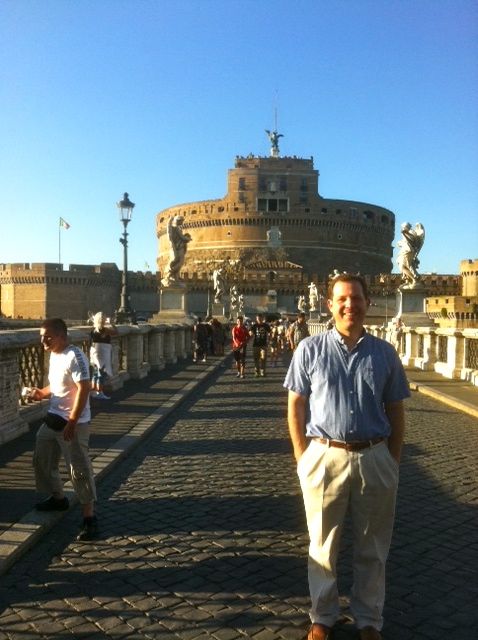
Two Jews walk into a castle in Rome…
OK, I forget the punchline.
Anyway, I need your help.
I’m in Rome for a few days (for the first time), and I need some advice. I’m ready to hit the usual suspects: the Sistine Chapel, the Colosseum, Caesar’s Palace, yaddio, yaddio, yaddio.
But I need some advice about hidden treasures, special restaurants, shops to purchase Roman candles, you name it.
I also could use a little basic Italian for dummies.
The only phrases I know are “Grazie”; “Arriva Derci”; “Stoo Gatz”; “Gabagool”; “Goomba” and “Badda Bing.” (Thanks, Tony and Carmela!)
So show a paizano some amore and leave your comments below. And I hope you are having a great weekend.
By Jonathan Miller, on Thu Sep 8, 2011 at 8:30 AM ET
While Americans seem bitterly divided over political issues, there’s one that seems to unite most of us: We all hate negative political TV ads.
So for this week’sHuffington Post column, I try to defend the indefensible: I argue that truthful negative ads can be quite valuable to voters and can help strengthen our democracy.
Call me crazy, but read on:
Recently, a close friend and early political supporter of
mine confided that she would no longer contribute to political campaigns that engaged in negative advertising.
And really, who could blame her?
Every election season, the television airwaves are barraged by a seemingly endless succession of 30-second jeremiads that manipulate the facts and embitter the public. Worse yet, many of the most vicious advertisements are paid for by shady, vanilla-named cartels who’ve maneuvered through loopholes in the Swiss-cheese-like election finance law to poison our politics without ever revealing the sources of their funding.
But all negative ads aren’t equally offensive. Indeed, some are critical to preserving public confidence in our political system.
Sound counterintuitive? A political campaign featuring only positive advertisements that focus on “the issues” might seem to be ideal.
But sometimes, the gauziest, most emotion-laded, goose-bump-inspiring advertisements can be the most deceptive, and can do the greatest disservice to the public dialogue. As with marketing for any product, positive political ads tend to exaggerate a candidate’s merits while ignoring his flaws. And the worst of them can paint a thoroughly misleading — or sometimes even completely inaccurate — picture of an official’s character, virtues and record on issues of import.
While the press can serve a mitigating role — calling out false claims and exposing whitewashes — a large and continually growing proportion of voters no longer follows the mainstream media, and many that do no longer trust what they see. Further, on the local level, decimated budgets have crippled the ability of many daily newspapers to engage in the necessary level of scrutiny of candidates and campaigns.
Accordingly, it’s often up to truthful negative ads to expose corruption and hypocrisy and to properly educate the public on the worth and merits of particular candidates.
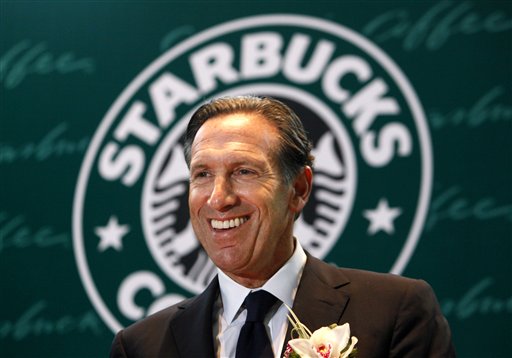
This evening, No Labels will host a “Conversation with America,” featuring Starbucks CEO Howard Schultz, to have a serious conversation about the problems of hyper-partisanship in Washington and the actions needed to break the political gridlock.
No Labels Co-Founder John Avlon, Maya MacGuineas, President of the Committee for a Responsible Federal Budget, and Rob Kaplan, Professor of Management Practice at Harvard Business School, will lend their expertise to our conversation on the fiscal crisis.
Since announcing our national telephone town hall last Friday, No Labels has created a stir in the media, capturing the attention of all the major television networks, prominent newspapers and local media outlets.
In Sunday’s New York Times a full-page ad ran from Howard Schultz announcing the call, as well as in USA Today.
We expect even more success as the post-call analysis influences the conversation this week with the GOP presidential debate and the President’s address to a joint session of Congress about job creation.
I encourage you to invite interested friends and family members to participate. If you have any questions, please feel free to contact Sarah from No Labels at 202-588-1990 or Sarah@NoLabels.org.
Apparently, the RP’s great radio face is in high demand. He was interviewed today by MyTechnologyLawyer radio about the debt crisis, the No Labels philosophy, and his hopes for future bipartisanship.
Contributing RP and former GOP Congressman Sherwood Boehlert was recently interviewed by his local paper about the debt ceiling crisis. Here’s an excerpt:
Former Congressman Sherwood Boehlert didn’t mince words when asked about Congress’ handling of the recent debt crisis.
“I think it was an embarrassment to the country,” he said.
Boehlert, a Republican, retired in 2006 after serving the area for 24 years as a U.S. Representative from New Hartford.
During his time in office, he said, he’d never seen a situation like the possible default that plagued the debating heads of Congress the last few weeks. And, he added, he couldn’t have thought of a worse way to handle it.
“I think it’s an anomaly, and I hope it’s a temporary anomaly,” he said.
After a media uproar, many Members of Congress now are holding meetings and others are complaining that they always intended to. Check out the following story:
All well and good. The problem is that there are doubts about the accuracy of its survey finding that 60 percent of the representatives aren’t holding an open town hall where constituents can come and question them on the issues.
At least that’s the case if Oregon is any indication.
The group claimed that only one of Oregon’s four congressman — Democrat Peter DeFazio — is holding town hall meetings this month. But it doesn’t take much looking to figure out that isn’t the case.
Similarly, Republican Greg Walden, shows on his website that he held a town hall in Heppner on Aug. 11 and “community meetings” in Long Creek the same day and in LaPine on Aug. 10. David Sykes, publisher of the Heppner Gazette-Times said the event in his community was advertised beforehand, and Walden did indeed show up and spoke to about 30 people.
“We wrote a big story about it,” said Sykes.
Democrat Earl Blumenauer is arguably the one Oregon congressman who didn’t hold the kind of town hall that No Labels is looking for. One of his aides, Willie Smith, said Blumenauer did hold an open meeting with residents of the Mirabella retirement community in Southwest Portland as well as local businesspeople in the Multnomah and Sellwood neighborhoods.
Smith said Blumenauer prefers to hold meetings focused on a particular issue instead of general town halls. “Earl doesn’t think they are necessarily productive,” he said, adding that they too often involve “you yell a talking point, I yell a talking point.”
Rep. Greg Walden, R-Ore.
Jonathan Miller, a former Kentucky state treasurer and a founder of No Labels, said his group believes the town halls are indeed important for building trust with voters. If nothing else, they show voters that members of Congress are actually working during the August recess.Miller said he was confident of the survey’s overall findings but conceded it could contain some mistakes.
What do you think? Should Congressmen hold town hall meetings, or was last summer’s experience an indication that they no longer serve a useful purpose?
Some 2012 candidates give out pies. Others label their speech location “the best place in the country”. All of them eat corn dogs and insist they’re not regular politicians. The cheese is getting thick in the presidential campaign.
So this week in on CNN’s “American Sauce” podcast they asked, “Can we take any of these politicians seriously?”
CNN looked to a recovering politician to answer this age-old question. Actually, The Recovering Politician.
Thanks for helping us kick off Fixing Politics Week in style.
Tomorrow, we use the opportunity to introduce to you our newest contributing recovering politician. He was the former multi-term state representative in the home state of the star of the RP’s favorite TV show. More significantly, his profile page will feature a picture of himself with that same TV star.
And no, the RP’s favorite TV show is most definitely not Two and a Half Men. (Sorry, Sheen, Kuchner and Duckie fans!) But our new contributing RP does offer his 5 1/2 solutions to fix American politics. We think you will find them very thought-provoking.
The RP’s appearance on Fox and Friends this morning was the stuff of legendary scandal. Unlike most cable TV talk show debates, there was no screaming, no storming off the set, not even any projectile vomiting to entertain the disappointed audience.
In fact, the three panelists: the RP, Santita Jackson (Jesse’s daughter and a popular Chicago radio host), and Dylan Glenn (a former GOP Congressional candidate in Georgia) seemed to agree on every major issue, particularly that hyper-partisanship and rigid ideology are destroying American politics.
So if you can stand rational discussion without angry recriminations, go ahead and watch the clip below. (And if it inspires you to join the No Labels movement that the RP promotes and whose message the other panelists echo, click here.)
Much to the great chagrin of all of us at the RP Nation, the RP is breaking his sacred vow of no-politics-week, and will appear on Fox News’ Fox and Friends talk show tomorrow (Friday) morning at 7:15 AM EDT.
The RP will be participating in a roundtable that will discuss a recent Media Research Center report which found that “in the first half of this year, NBC, ABC and CBS morning and evening news shows attached the term ‘conservative’ to a presidential contender 62 times, while during the same period in the presidential race in 2007, ‘liberal’ came up only three times.”
Tune in tomorrow as the RP enters the lions’ den for the first time in 23 years. And to prepare yourself, check out video of the last time the RP appeared on a contentious cable TV talk show (disguised as Justin Bieber — years before the Beebs was born):


 Two Jews walk into a castle in Rome…