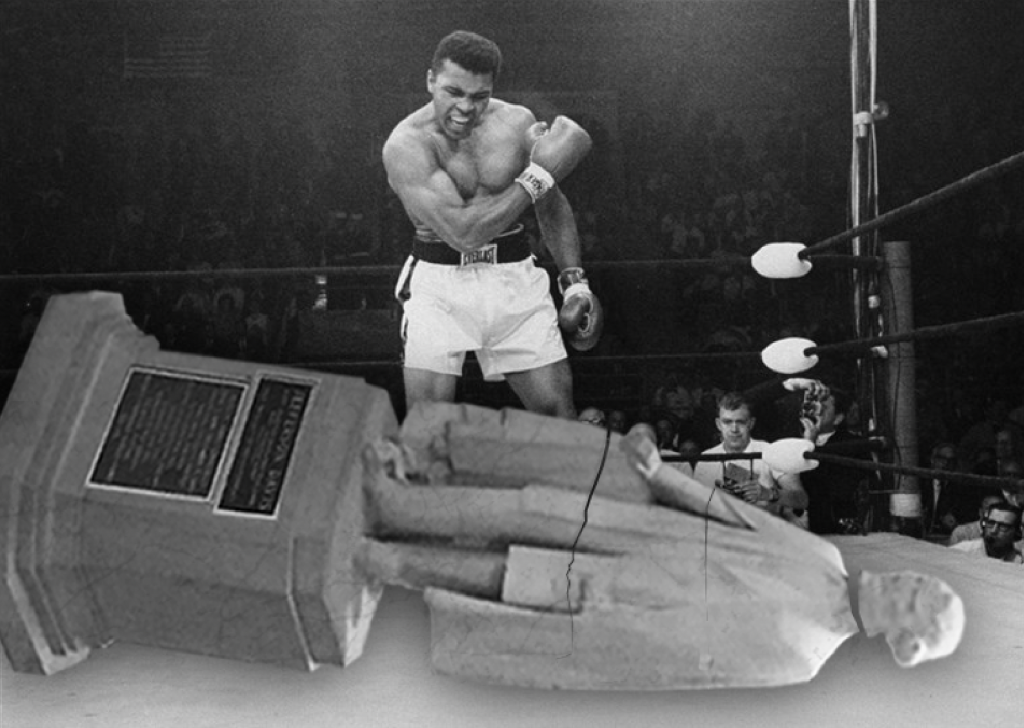
Please sign the petition below to remove the statue of Jefferson Davis currently in Kentucky’s Capitol Rotunda, and replace it with a tribute to Muhammad Ali, “the Louisville Lip” and “the Greatest of All Time.”
I just heard from the Ali family: It is the Champ’s belief that Islam prohibits three-dimensional representations of living Muslims. Accordingly, I have adjusted the petition to call for a two-dimensional representation of Ali (a portrait, picture or mural) in lieu of a statue.
UPDATE (Tuesday, December 2, 2014)
In this interview with WHAS-TV’s Joe Arnold, Governor Steve Beshear endorses the idea of honoring Muhammad Ali in the State Capitol (although he disagrees with removing Davis). Arnold explores the idea further on his weekly show, “The Powers that Be.”
Click here to check out WDRB-TV’s Lawrence Smith’s coverage of the story.
And here’s my op-ed in Ali’s hometown paper, the Louisville Courier-Journal.
UPDATE (Saturday, June 4, 2016)
In the wake of the 2015 Charlestown tragedy, in which a Confederate flag-waving murderer united the nation against racism, all of the most powerful Kentucky policymakers — U.S. Senator Mitch McConnell, Governor Matt Bevin, Senate President Robert Stivers and House Speaker Greg Stumbo — called for the removal of the Davis statue from the Rotunda. Today, as we commemorate last night’s passing of Muhammad Ali, there is no better moment to replace the symbol of Kentucky’s worst era with a tribute to The Greatest of All Time.
UPDATE (Wednesday, June 8, 2016):
Great piece by Lawrence Smith of WDRB-TV in Louisville on the petition drive to replace Jefferson Davis’ statue in the Capitol Rotunda with a tribute to Muhammad Ali.
UPDATE (Thursday, June 9, 2016):
Excellent piece on the petition drive by Jack Brammer that was featured on the front page of the Lexington Herald-Leader.
Highlight of the article:
Miller said he has received a few “angry comments” on his call to honor Ali.
“One of them encouraged me to kill myself,” he said. “You can quote me that I have decided not to take their advice.”
UPDATE (Friday, June 10, 2016)
The petition drives continues to show the Big Mo(hammed): check out these stories from WKYU-FM public radio in Bowling Green and WKYT-TV, Channel 27 in Lexington:
UPDATE (Saturday, June 11, 2016):
Still not convinced? Check out this excerpt from today’s New York Times:
By Stephanie Doctrow, RP Staff, on Wed Nov 2, 2011 at 1:30 PM ET
Trouble sleeping lately? New research suggests that people who feel lonelier are more likely to have restless sleep. [Time]
Bad news for you sommeliers out there. A new study shows that women who routinely have even small amounts of alcohol have an elevated risk of breast cancer. [NY Times]
More depressing science: why our brains our hard wires to spend, spend, spend. [Newsweek]
Check out these tips on making it out of the grocery without a lengthy receipt and a cart full of junk food. [Prevention]
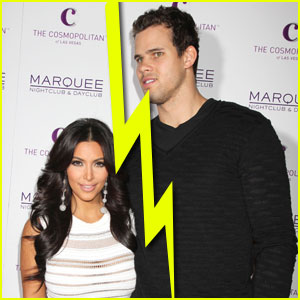
How long was their wedding special advertised on television? Likely longer than their actual marriage lasted. Here’s a list of things that lasted longer than Kim Kardashian’s marriage. [The Daily Beast]
Ever wondered whether men or women are funnier? Here’s a study that examines humor preferences in men and women. Is it possible that both genders prefer male humor? [Science Daily]
We all know Republican presidential candidate Rick Perry is conservative, but just how conservative? Apparently he is supporting efforts to repeal same-sex marriage laws and defund Planned Parenthood programs. How will this affect his campaign? [Huffington Post]
By Jonathan Miller, on Wed Nov 2, 2011 at 12:00 PM ET
No Labels — a national grassroots movement co-founded by the RP — is formulating a comprehensive government reform package to address the devastating impact of hyper-partisanship on American politics. It is asking Americans to contribute their ideas for meaningful reform.
Below is the RP’s initial proposal — to address the horrible backlog of Presidential appointments for critical federal positions. To comment on the RP’s proposal, or to suggest your own ideas, click here.
Our government works well only if good people are in the right positions. But what happens if many of the top positions in government are left empty?
Such is the case in America. After the Obama administration’s first 100 days in office, only 14 percent of Senate-confirmed positions had been filled. Even at the end of 2010, nearly two years into President Obama’s term, 22 percent of the more than 500 government positions dependent upon Senate confirmation were still vacant or filled only by “acting” officials.
When a nomination comes to the Senate floor, Senators can vote in favor of the nomination, against the nomination, without recommendation, or choose to do nothing. Inaction is often the path of political expediency. But political expediency often leaves American citizens without a fully staffed and functioning government.
Former Ohio Attorney General Richard Cordray is a case in point. In July, President Obama nominated Cordray to head the Consumer Financial Protection Bureau, a new agency designed to increase oversight of the much-maligned financial sector. Although Cordray’s nomination was approved by the Senate Banking Committee in early October, it has not been scheduled for a vote in the full Senate. Without a confirmed director, the bureau is powerless to protect consumers from abuses by the same non-bank financial institutions that left America vulnerable to its worst financial crisis since the Great Depression.
President Obama is not the first president who has faced confirmation problems — during the Bush administration, America went without a confirmed national security team for six months. Presidents have struggled to staff the government for as long as politicians have put political games ahead of the country’s best interests. For real change to occur, America must commit to clear and efficient voting processes and not continue to be sidelined by petty delays.
To ensure Americans receive the government they pay for, No Labels proposes that all presidential nominations that require Senate confirmation receive an up or down confirmation vote within 90 days of submission. This will ensure government positions will be filled with qualified people. And if the Senate votes against a candidate, presidents can move on and find someone else to fill the role in a timely manner.
Read the rest of… The RP: No Delays — Confirm in 90 Days
The Democratic Party has a faith gap–and if anything it is getting wider. The Gallup Poll has just released data showing a chasm between the political leanings of self-described “very religious” whites, with 62% identifying themselves as Republicans and a scarce 27% identifying as Republicans. At this point, no other demographic skews more heavily toward Republicans than faith oriented whites, and the electoral consequences are unmistakable: it correlates almost evenly with the overwhelmingly Republican preferences of southern whites, who are the most religious whites in America, and further defines why a slew of states with large blocs of evangelical leaning whites are drifting away from Barack Obama, from Ohio to Virginia, to Florida, to Indiana, to Colorado.
There is a mindset in some Democratic circles that religious whites are disproportionately economic conservatives who are natural Tea Party sympathizers. While Gallup did not test specific issues, I have seen a slew of polling data from Alabama–a top two ranked state in football and religiosity–that shows religious whites are often economic populists, distrust corporate elites, don’t mind putting more taxes on those elites, and that surprising shares of them embrace the notion of more government spending on education and, yes, safety nets like Medicaid. They are proud, church-going denizens of the 99 percent, in Occupy Wall Street parlance.
But if the economic lean of religious whites is surprisingly to the left, their stance on social issues leans hard in the other direction. The Public Religion Research Institute recently found that in a country where voters are sharply split on abortion, only 29% of “evangelical” whites favor its legalization, while almost two thirds oppose. Similarly, on same sex marriage, which elite opinion now conclusively favors, and on which the public is split in half, over 80% of white evangelicals oppose legalizing gay marriage.
So, in practice, religious whites have voted their sectarian leanings over their economic tendencies. Breaking that pattern was until recently a major Democratic preoccupation. A succession of Democratic thinkers, most notably Jim Wallis, tried to pry the door open by re-casting liberal policies on healthcare, poverty, and educational access as faith-based priorities, grounded in Matthew’s New Testament admonition to advance the interests of the “least of these”. Barack Obama’s keynote address in 2004 sounded an eloquent note that “in the blue states, we worship an awesome God and in the red states, we have some gay friends.” In 2005, Obama’s first high profile speech as a Senator linked his political vision to his faith and its promises of a more seamless community, and during the years of Obama’s rise, there seemed to be a genuine affinity between he and Rick Warren, the avatar of the “purpose driven life” and an evangelical icon.
Read the rest of… Artur Davis: The Democratic Party’s Faith Gap
College admissions rates have consistently decreased over the past several years, often with dramatic annual drops. See here for the Top 100 Lowest Acceptance Rates in Fall 2010. [US News]
The Common Application is an online, standardized first-year application form and is currently used by 456 colleges across the the United States and internationally. Its widespread implementation has had palpable effects on college admissions trends, such as students applying to many more schools that they ordinarily would have. See here for the Common Application website, as well as an account of the effects the University of Michigan saw immediately following the form’s implementation in its admissions process. [Common Application][Ann Arbor]
While the number of applications at many universities is continuing to increase, colleges are going to be seeing a smaller number of applicants as high school graduation rates are projected to decrease over the next four years from the 2009 record high. In fact, the number of schools seeing decreasing numbers of applications is growing alongside those seeing more. As more students consider two-year or only public colleges, the economy will perhaps take its toll on college admissions. [The Chronicle]
Social media is changing college admissions processes for both the applicants and admissions counselors. For the applicants, information about colleges is now more widely available through Facebook pages and blogs, and means of contacting current students have become much more accessible. For the admissions counselors, a new means of screening applicants is visiting a student’s Facebook page. See here for an article commenting on both of these phenomena, as well as a report conducted in 2008 by KAPLAN on the number of admission officers utilizing social media to evaluate applicants. [Politics Daily][KAPLAN]
By Stephanie Doctrow, RP Staff, on Tue Nov 1, 2011 at 1:30 PM ET
Former Gov. Mark Sanford of South Carolina is reinventing his career… as a paid contributor on Fox News. Call it the Spitzer Effect. [NY Times]
A new level of experiential journalism: The Daily paid for one of its reporters to take Oxytocin for a week so she could report on its, ahem, affects. [The Daily]
How do the presidential candidates compare when it comes to their use of Twitter? [Time]
The debate continues on whether or not journalists should conceal their political views from the public. [The Atlantic]
Look at how different media organizations decided whether or not to reveal the names of the jurors in the Casey Anthony case. [Poynter Institute]
As the country continues to debate the role of the federal government in the health insurance arena, we ought to consider the historical framework of risk and liberty upon which America rests. [YouTube – The Federalist Society]
Interesting note from about 5 years ago about Milton Friedman’s evaluation of liberty and drugs. Basically, Friedman concluded that drugs themselves are not the problem, but rather their illegality causes the troubles. [The People’s Voice]
Here is a letter from Libertarian Party Chairman Mark Hinkle addressed to the Occupy protestors. Both groups are upset about crony capitalism, but the Libertarians would rather direct their frustrations at Washington, DC rather than Wall Street. I agree. [Libertarian Party]


 Blog this!