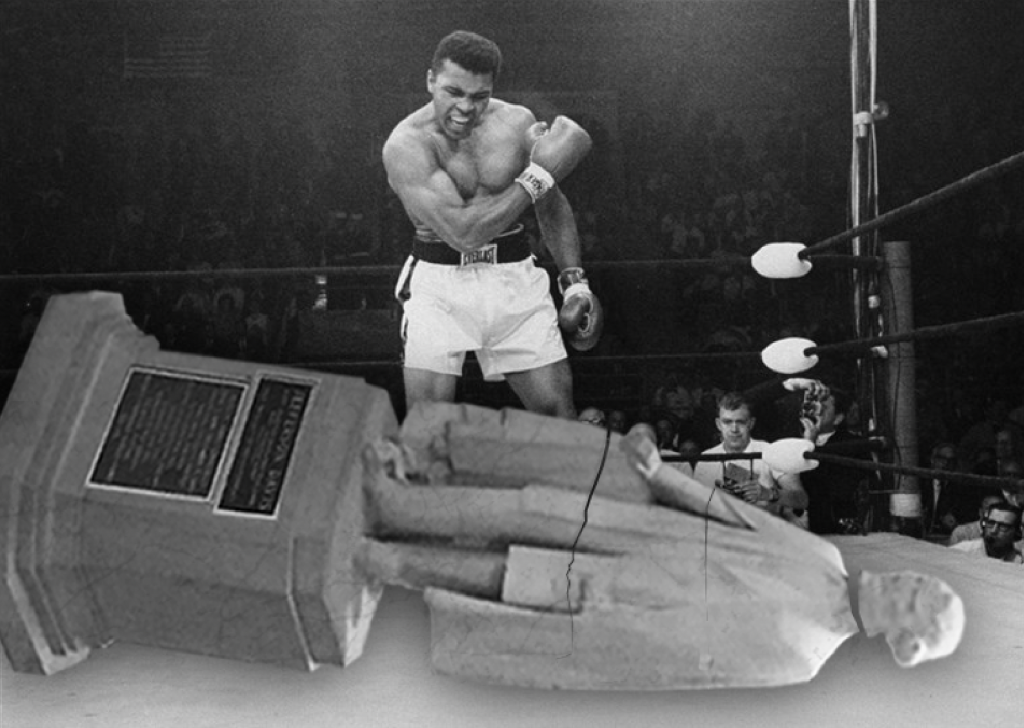
Please sign the petition below to remove the statue of Jefferson Davis currently in Kentucky’s Capitol Rotunda, and replace it with a tribute to Muhammad Ali, “the Louisville Lip” and “the Greatest of All Time.”
I just heard from the Ali family: It is the Champ’s belief that Islam prohibits three-dimensional representations of living Muslims. Accordingly, I have adjusted the petition to call for a two-dimensional representation of Ali (a portrait, picture or mural) in lieu of a statue.
UPDATE (Tuesday, December 2, 2014)
In this interview with WHAS-TV’s Joe Arnold, Governor Steve Beshear endorses the idea of honoring Muhammad Ali in the State Capitol (although he disagrees with removing Davis). Arnold explores the idea further on his weekly show, “The Powers that Be.”
Click here to check out WDRB-TV’s Lawrence Smith’s coverage of the story.
And here’s my op-ed in Ali’s hometown paper, the Louisville Courier-Journal.
UPDATE (Saturday, June 4, 2016)
In the wake of the 2015 Charlestown tragedy, in which a Confederate flag-waving murderer united the nation against racism, all of the most powerful Kentucky policymakers — U.S. Senator Mitch McConnell, Governor Matt Bevin, Senate President Robert Stivers and House Speaker Greg Stumbo — called for the removal of the Davis statue from the Rotunda. Today, as we commemorate last night’s passing of Muhammad Ali, there is no better moment to replace the symbol of Kentucky’s worst era with a tribute to The Greatest of All Time.
UPDATE (Wednesday, June 8, 2016):
Great piece by Lawrence Smith of WDRB-TV in Louisville on the petition drive to replace Jefferson Davis’ statue in the Capitol Rotunda with a tribute to Muhammad Ali.
UPDATE (Thursday, June 9, 2016):
Excellent piece on the petition drive by Jack Brammer that was featured on the front page of the Lexington Herald-Leader.
Highlight of the article:
Miller said he has received a few “angry comments” on his call to honor Ali.
“One of them encouraged me to kill myself,” he said. “You can quote me that I have decided not to take their advice.”
UPDATE (Friday, June 10, 2016)
The petition drives continues to show the Big Mo(hammed): check out these stories from WKYU-FM public radio in Bowling Green and WKYT-TV, Channel 27 in Lexington:
UPDATE (Saturday, June 11, 2016):
Still not convinced? Check out this excerpt from today’s New York Times:
It’s my first time in New Hampshire, for the “First in the Nation” primary of 2012. I’m only days into a year-long hiatus from Penn Law to work for esteemed message guru and owner of Luntz Global, Dr. Frank Luntz. While snow and rain have been noticeably (and welcomingly) absent from New Hampshire, political and journalism might have not. Here are some highlights so far…
Smoothest Operator Award #1: New Jersey Governor Chris Christie – Gov. Christie, on stage in Exeter next to Mitt Romney, was rallying Mitt’s Militia when a few Occupiers started disrupting. Or so they tried. Christie bellows, “Oh really?” into the microphone and reminds the rabble-rousers he has created 60,000 new jobs in NJ. But he does so without upstaging the candidate, bringing the focus back to Romney by proclaiming him the only one capable of creating millions of jobs in America and kicking Obama out of 1600 Pennsylvania Avenue.
Smoothest Operator Award #2: Rick Santorum – Now best known for his Iowa surprise, Santorum has always been a deft political operator. He always impressed me during the few times I met him. But his event on January 7 in Hollis, NH scored serious points. Santorum arrives at a barn to, well, too many people to fit in the barn. With hundreds already inside, and hundreds eagerly awaiting his arrival outside the barn, Santorum gives everybody what they wanted from him: Time. Santorum gets on a rock outside the barn, stumps for a few minutes with those of us who arrived on the later side, and even takes several questions. Totally unscripted, totally smooth.
Best “Wow” Moment: Sitting in the lobby of the Radisson Hotel in downtown Manchester late one night, watching Dan Rather, Bob Schieffer, Joe Scarborough, Brett Baier, and Chris Matthews pow-wow. Think about how many times we’ve let those giants of journalism into our living rooms to break down the most transformational world events of the last 50 years . . .
Read the rest of… Zac Byer — Reporting from the NH Primary
–Walter Benjamin, The work of Art in the Age of Mechanical Reproduction
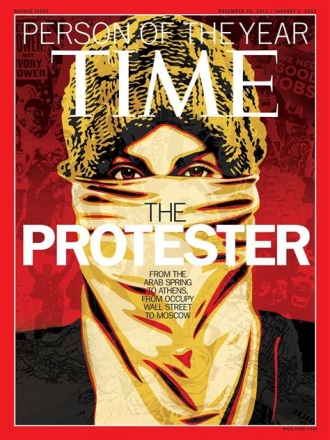
Time Magazine recently named “The Protester” its 2011 “Person of the Year.” In a year defined by an Arab Spring where the people of Africa and the Middle East risked life and limb to demand democracy, and Americans “Occupied Wall Street” to reclaim democracy, Time’s choice made perfect sense.
But I submit that a strong runner up for “Person of the Year” should be “Social Media”—that is, “Facebook,” “Twitter,” and handheld devices (PDA’s, etc). No, these social media tools aren’t actual people, but they provided the tools for the protesters to organize and reveal to the world their plight.
When studying for my doctorate, I immersed myself in the Frankfurt School of philosophy . Many of its leading thinkers were weary of the rise of technology as a tool for totalitarians. Theodor Adorno even warned of a “culture industry” wherein consumerism masks itself as choice, instilling a false sense of personal freedom when there was no real freedom.
A dissenting view within the Frankfort School came from Walter Benjamin, who believed new technologies (in the context of his writing, the increased use of film and photography) could have a political effect that could be liberating if placed in the hands of the people. Benjamin, a Jew fleeing from the Nazis, committed suicide when it appeared he was going to be captured and sent to concentration camps. At a time when Hitler was in power and using film for purposes of mass propaganda, Benjamin’s technological optimism, in context, seems surprising.
Read the rest of… Greg Harris: The Revolution Will Not Be Televised; It Will Be Tweeted
I’ve enjoyed mixing it up and teasing it out—for fun and with friends.
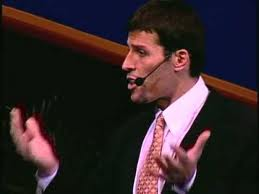
We’re all tired and need a wrap on this. Look, all I’m saying is that I won’t be surprised if Mitt Romney shows up at the next NH debate with a headset mic a la Anthony Robbins.
He can pull it off, look great, impress listeners. Heck, I’ll even buy his CD set. He’ll score points for fashion and suave, but lose votes—again.
Or, as Krystal Ball so succinctly put it, instead of convincing voters “he’s perfect” to be their next president, Mitt will seem “too good to be true.” A subtle but important distinction for recovering politicians.
So, no, Mitt probably doesn’t need to punch out Rick Santorum Tony Soprano style (even if he wants to). But he darn sure better muss his hair and stay away from headset mics as America focuses in to finally decides if Mitt is real enough — and not too good enough — to be president.
Remember, we voters can sometimes steal a page from Goldilocks, as we all look for the presidential candidate that is neither too big nor too small, neither too hot nor too cold. But just right. And just right for the times we face.
Some people just deserve good things in life. Ya, we know Mitt’s daddy owns the car dealership and got a Corvette for his 16th birthday, but after all, he looks like the quarterback. He is not like the rest of the kids in shop class, English, debate or pep-band. He is just a little better. He doesn’t have to one-up, he was born up.
In 1920, Warren Harding looked like Presidential timber too and campaigned on the thriller banner of “normalcy.” Some people just “got it go’n on.” Not like the rest of us who have had to pull our selves up the hard way, make hard calls, and pay the personal price for our political decisions. Mitt has always had someone else pay, or someone else’s money to pay. Mitt Harding has the look and was smart enough to choose the right parents. People want to have their picture taken with him, but don’t really want to talk to him, akin to taking picture at a car show.
So back to Harding: He looked like President, so let’s run him for President. The key to that borrowed historical back room quote is “who” is part of “let’s?” History showed us who with Teapot Dome.
Read the rest of… The RPs Debate Presidential Leadership: Jason Atkinson Rebuts
Jeff is so right about the difference between presidential races and state races. It is much easier for one candidate to have the resources to buy those down-ticket races.
While we have been asking about how a candidate is perceived by disinterested voters, I do think we should remember that the opposing campaign also has a chance to impact those perceptions. A good media buy with cutting ads can hurt a candidate. What the Bill Clinton camp did to Bob Dole in 1996 is a good example.
I also want to say that if Romney wins the primary and faces Obama, the question about who you want to have beer with is hard for voters to answer.
Obama is not a guy people want to have a beer with any more than Romney is.
I think we should delineate between presidential elections and most other types — gubernatorial, House, Senate, etc. Presidential campaigns are exceptional. The candidates (especially in years like this when there are 38 debates) face a lot of scrutiny; they are inspected closely by the media, party activists, and to some extent rank-and-file voters (at least in the early states).
This, however, is not the case in most races. As long as candidates for House can raise $1-2M and candidates for US Senate or Governor can raise $5-10M, they can communicate effectively and thoroughly via TV ads. So I think that in those races the most important things are money, name ID, and surface likeability – as opposed to substantive ideas that can be put into action. This is because candidates with money are able to circumvent the press and the scrutiny of said ideas, and can saturate the airwaves with ads penned by others in which they mouth 30-60 seconds of reassuring bromides.
I’m a Johnny-come-lately to what sounds like an incredible conversation, so I will wade in very selectively, with these random observations:
I like Jeff’s observations if only because they are the best explanation for why a decidedly average looking guy like me didn’t go further! More seriously, I think we will forever remain on the lookout for an explanation of what makes winners in politics. If it were all looks and charm, Kennedy crushes Nixon, instead of beating him by a vote per precinct; I’ve seen the charming losers–I vividly recall from my candidate recruitment days at the DCCC, a Nebraska guy whose looks had female staffers rearranging their schedules to meet him; the voters were less enraptured than the staffers and the online world; he lost by about 20 points — and I’ve seen the winners whose charisma would’t carry them past the corner next to the punch bowl in most other settings.
My best guess is that for all our jaded reasons not to believe it, issues do matter, but sometimes only in the most reductionist sense–“does the guy or lady believe in people like me?”;”is this person going to deliver on the one or two things I really value?” I deliberately don’t use the word trust, by the way, because I think the trust quotient is so low in politics today that relying on it proves too little. I also don’t mean to endorse the very test I describe — part of leadership is sometimes deciding to deliver not on the one thing you care about, but the one thing that really will work better. Sometimes, “believing in people like me” means leading too narrowly, and shortchanging the broader good for one faction.
Great point, Ron, but let me play the contrarian’s contrarian on looks and politics and point out that although I brought up the issue and am trying to make the case that we need to think more deliberately and deeply about the candidates than we do, I still seem to vote for the better looking ones myself.
I guess what I’m trying to say is that it’s important to be deep when discussing presidential politics, but don’t underestimate the shallow. Not because of shallow voters.
Read the rest of… The RPs Debate Presidential Leadership: John Y. Defends


 Blog this!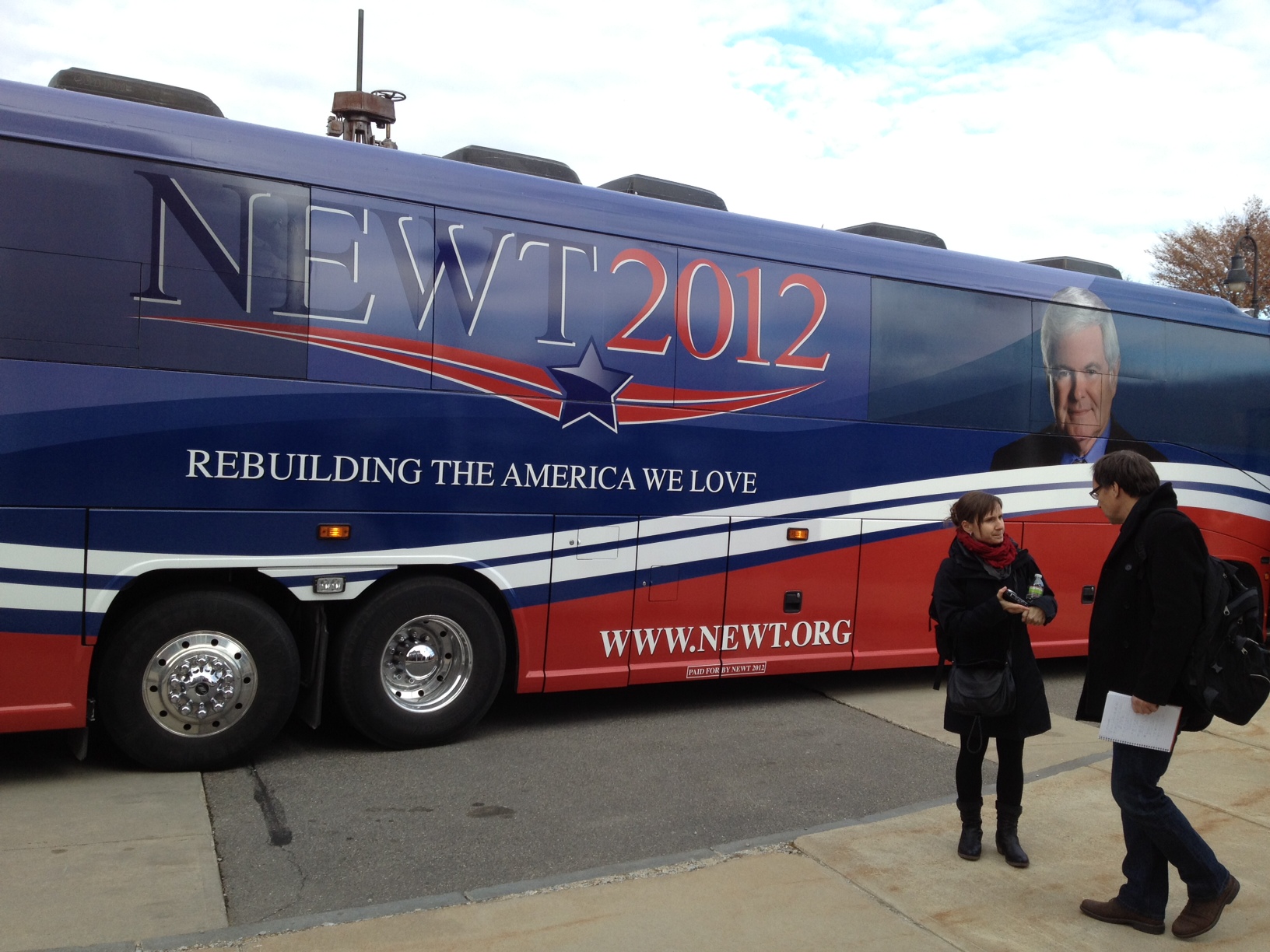


 Jason Atkinson