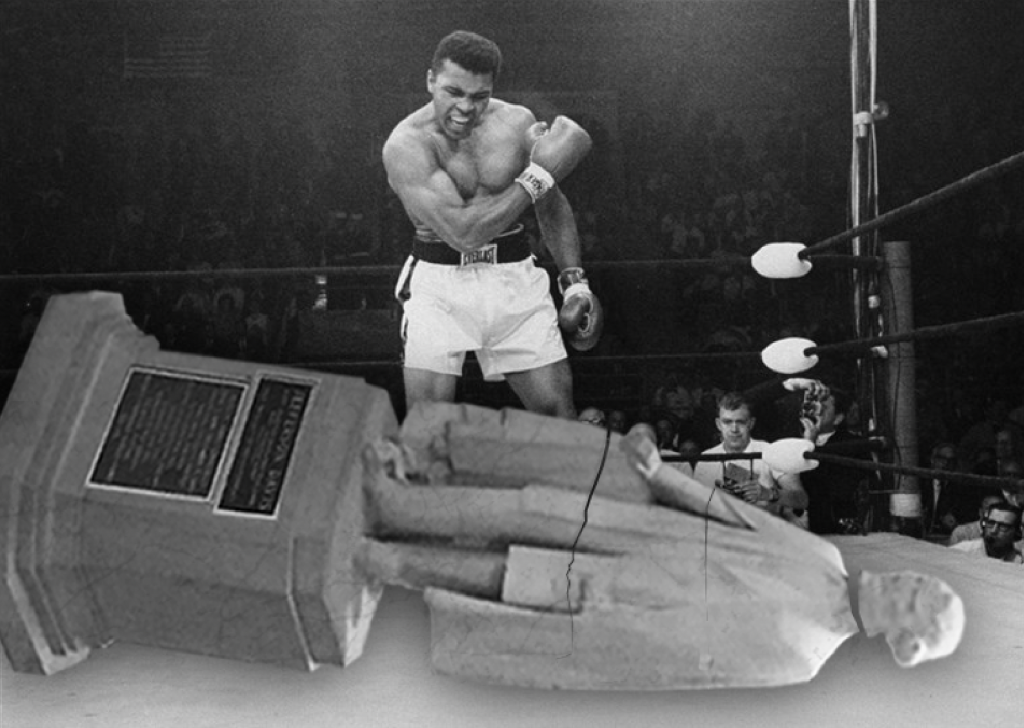
Please sign the petition below to remove the statue of Jefferson Davis currently in Kentucky’s Capitol Rotunda, and replace it with a tribute to Muhammad Ali, “the Louisville Lip” and “the Greatest of All Time.”
I just heard from the Ali family: It is the Champ’s belief that Islam prohibits three-dimensional representations of living Muslims. Accordingly, I have adjusted the petition to call for a two-dimensional representation of Ali (a portrait, picture or mural) in lieu of a statue.
UPDATE (Tuesday, December 2, 2014)
In this interview with WHAS-TV’s Joe Arnold, Governor Steve Beshear endorses the idea of honoring Muhammad Ali in the State Capitol (although he disagrees with removing Davis). Arnold explores the idea further on his weekly show, “The Powers that Be.”
Click here to check out WDRB-TV’s Lawrence Smith’s coverage of the story.
And here’s my op-ed in Ali’s hometown paper, the Louisville Courier-Journal.
UPDATE (Saturday, June 4, 2016)
In the wake of the 2015 Charlestown tragedy, in which a Confederate flag-waving murderer united the nation against racism, all of the most powerful Kentucky policymakers — U.S. Senator Mitch McConnell, Governor Matt Bevin, Senate President Robert Stivers and House Speaker Greg Stumbo — called for the removal of the Davis statue from the Rotunda. Today, as we commemorate last night’s passing of Muhammad Ali, there is no better moment to replace the symbol of Kentucky’s worst era with a tribute to The Greatest of All Time.
UPDATE (Wednesday, June 8, 2016):
Great piece by Lawrence Smith of WDRB-TV in Louisville on the petition drive to replace Jefferson Davis’ statue in the Capitol Rotunda with a tribute to Muhammad Ali.
UPDATE (Thursday, June 9, 2016):
Excellent piece on the petition drive by Jack Brammer that was featured on the front page of the Lexington Herald-Leader.
Highlight of the article:
Miller said he has received a few “angry comments” on his call to honor Ali.
“One of them encouraged me to kill myself,” he said. “You can quote me that I have decided not to take their advice.”
UPDATE (Friday, June 10, 2016)
The petition drives continues to show the Big Mo(hammed): check out these stories from WKYU-FM public radio in Bowling Green and WKYT-TV, Channel 27 in Lexington:
UPDATE (Saturday, June 11, 2016):
Still not convinced? Check out this excerpt from today’s New York Times:
By Erica and Matt Chua, on Tue Nov 5, 2013 at 8:30 AM ET
ur Couchsurfing host asked us, “why do people visit Santiago?” Almost interrupting himself he clarified that he believed his city is a great place to live, but that there isn’t much for tourists. Having been there over a dozen times myself I wondered if anyone actually makes Santiago a destination. Then I remembered that one of my friends actually visited Santiago and at the time I wondered: why? Is Santiago worth a couple of days?
Do people visit for the views? Probably not. Even though one of the world’s great mountains is unbelievably close, you probably won’t see it because the city’s smog often obscures the view. OK…then is it the city itself?
The city of Santiago is clean and functional, much like Omaha or Minneapolis. There is as little to dislike as there is to thrill. Considering that the city was founded almost 500 years ago, it lacks the antiquated charm of other colonial towns in South America. It has neither the distinctive European charm of Buenos Aires nor the grittiness of La Paz. Even worse, it’s bested on both sides by it’s easily accessible neighbors of Valparaiso, Chile and Mendoza, Argentina. Head west 90 minutes and you are in the literal San Fransisco of South America, Valparaiso, which rises from the Pacific in a kaleidoscopic collage of precariously placed buildings. Head a few hours to the east and you’re in the Napa Valley of South America, Mendoza, which treats it’s visitors to over sized glasses of wine paired with overflowing Argentine barbeque. Pity poor Santiago, the city serves better as a gateway to other places than a destination in it’s own right.
Read the rest of… Erica & Matt Chua: Skippable Santiago, Chile
By John Y. Brown III, on Mon Nov 4, 2013 at 12:00 PM ET
Favorite family Halloween story ever.
When my son Johnny was 3 he dressed up like Batman. He was dressed in full character and kept the mask on at all times–and although only 3 he was a very friendly and talkative child already.
We stopped by Blockbuster before Trick-or-Treating and there were two teenagers, too cool for Halloween (or life), who glanced at us and gave us a scoffing, dismissive look—as if to say “A father and son on Halloween. How lame.”
They had piercings all over, tattoos and Goth attire. Even though I was in my mid 30s, rebellious teens intimidated me so I nudged Johnny away from them.
When I wasn’t looking, Johnny slipped away from me and when I heard him he was making conversation with the two uber-cool teens.
“Hey you guys!” He said cheerfully. “I’m Batman.” No response…just a look of disgust from the teens.
Then Johnny added, “So who are you guys dressed up as?”
It was a total smack down by a 3 year old to two teens. They were speechless and humiliated with how silly they looked. They tucked tail and slinked out of the door.
I’ve always felt safe when I was with Johnny since then.
Q: I just started working full-time on my first political campaign, and I have noticed that many of our decisions are guided by polling and not by a firm belief one way or the other. It has been disheartening to see how someone I believed would be a strong leader is so easily swayed by the polls and is apparently only concerned with getting elected. Am I working for the wrong candidate, or is this what I signed up for? —L.D., St. Louis
The way I interpret your question, I don’t think that’s what you signed up for. But let me explain.
Nearly every candidate worth her salt—at the state legislative level and higher in most states, at this point— uses polls. But good leaders don’t use polls to figure out their positions on issues. They use polls to figure out which of their issue positions they should highlight and which they should downplay. They use polls to figure out how to talk about the issue positions they want to highlight. And they use polls to figure out which attacks merit a response. That’s being poll-savvy, which is smart—not poll-driven, which can be pathetic.
So think about whether your candidate is poll-savvy or poll-driven. And even if he is the latter, ask yourself: Is it awful for a candidate to poll voters before taking a position on an issue or issues? Is that not in some respects what representative democracy is about? Taken to an extreme, obviously, it’s troubling—no one wants to vote for a weather vane. But if a candidate doesn’t have an established position or strong feelings on an issue, I don’t see a problem with taking the pulse of the electorate before deciding.
So is this what you signed up for? No. But I think that may be more about you than it is about him.
Q: Are you following the race for New York City Council Speaker? Seems like any one of a number of people could win. When it gets down to brass tacks, how do legislators make up their minds on leadership votes? Do they vote based on the candidates’ ideology, race, gender, geographic roots or intangible leadership qualities? —A.M., New York CityNone of the above. In my experience, legislators’ votes in leadership races are almost always about one thing: themselves. Now, I know this sounds counterintuitive, but hear me out.
Suppose you are the Economic Development Committee vice chair and you want to chair the committee. The current chair, whom you despise and often quietly disagree with, is running for Speaker against another member whom you like and generally agree with, and you expect the vote will be close. You will probably vote for the person you despise, because—unless power in that particular legislative body is completely centralized— the chance to chair Eco Devo is probably more alluring to you than the chance to have someone as Speaker whom you like. If power in the chamber is absolutely centralized, and if you totally trust the candidate you like to depose the current chair if she wins (a rare move in most chambers), and if you trust her to appoint you as the new chair, and if you then trust her to give you some power as chair, then you may want to vote for the person you like. As you can see, there are a lot of ifs there.
To take a somewhat simpler example, if you are a freshman Council member who first and foremost aspires to be Speaker, and one of your closest allies, also a first-term member, is running for Speaker against a second-term member whom you dislike, you’ll probably vote against your ally, because if she is elected Speaker and consolidates power, you will likely be termed out before there is another open seat race for Speaker, since you wouldn’t challenge an ally who is the sitting Speaker.
These two examples serve to make a broader point: Leadership votes are usually as much if not more about the ambitions of rank-and-file members than they are about the qualities of the aspirants.
Read the rest of… Jeff Smith: Do As I Say, A Political Advice Column
I’m not much of a car guy but when Ford announced it was dumping its Mercury line I got a little nostalgic. I wasn’t born when “Rebel Without a Cause” was released in 1955 but remember seeing the movie as a kid and being in awe of James Dean. Who can’t relate to the lonely rebellious outsider, with his slicked back hair and leather jacket, trying to fit in? No one remembers the name of the character Dean played (Jim Stark). After a tragic death James Dean became the character in our minds for eternity. Don’t get me started on Natalie Wood. The thing everyone remembers and the real icon from the classic movie is the cool Mercury James Dean drove. It was a 1949 six-passenger coupe, fitted with a V-8 and an attitude to match Dean’s character. The Merc was coolness personified.
Don’t you wonder how the Merc became so cool coming from Ford where Henry’s motto was, any customer can have a car painted any colour that he wants so long as it is black. The Model T was the iconic product of a new industrial era. Henry Ford gave us the assembly line and mass production. He didn’t give us cool. For that you have to look to his only son Edsel, who had a better idea. I know we associate the name Edsel with failure but that is because of a disastrous Ford model that was introduced in 1958 well after Edsel had died in 1943. Edsel Ford was not a failure.
Edsel was far more interested in design and flashier styling for cars than his father. He relentlessly advocated for more modern cars reflecting consumer tastes to replace the Model T but was consistently overruled by his father. It wasn’t until sales of the Model T started to decline that Edsel began having influence on car body design and performance specifications. He was very interested in high performance cars and many give him credit for customizing the first “Hot Rod” with a V-8 engine. In 1939 he started the Mercury brand from scratch. It was a way to offer consumers a car that was more stylish than a Ford at a price point between a Ford and the luxury Lincoln brand. Edsel brought the power of design to Ford and had a big impact on the auto industry.
Mercury really took off with the introduction of the 1949 model, the Mercury Eight. Not only did it become famous as James Dean’s ride in “Rebel Without a Cause” it quickly was popular with car customizers. Maybe it was an early example of open source innovation. An entire ecosystem of hobbyists and suppliers grew up around customizing the 49 Mercury. Hot Rod and Motor Trend featured pictures and stories about the coolest chopped Mercs. Hobbyists today still customize old Mercs and there are fiberglass replicas in production that are popular with today’s kit car and hot rod enthusiasts. Not many cars have had that much staying power and impact.
Unfortunately Mercury’s heyday was in the 50′s. It hasn’t been interesting since with few remarkable models. I am not surprised that Ford is dumping the brand. It has no clear positioning in the market. I can’t think of a single person I know who owns one. While it makes sense for Ford to consolidate its brands and platforms it didn’t stop me from a little nostalgia when I heard that Mercury, the messenger of the Gods, had a simple message for the brand, you’re fired. For all rebels without a cause it is worth taking a moment to remember what the 49 Merc stood for.
By John Y. Brown III, on Fri Nov 1, 2013 at 1:30 PM ET
The Stages of Development for Halloween:
1) Scared. (Ages 1-7) Halloween musters up images of ghosts and goblins, witches and werewolves; ghost stories, horror movies and creepy images dominate our understanding of Halloween.
2) Candy (Ages 8-12) The frightening images promoted by Halloween are displaced by the more practical desire to acquire and ingest candy.
3) Fun (Ages 13-24) Halloween becomes an excuse to party with our peers. Candy and Fear are no longer primary ways of understanding Halloween and are replaced with opportunities for interacting with the opposite sex, dancing, being fabulous and related behaviors.
4) Parenting–(Ages 25–49) Halloween becomes a wholesome family activity for parents and children to spend time together decorating the house, carving pumpkins, Trick-or-Treating, sipping hot apple cider and eating candy.
5) Partial Alienation (Ages 50-59) These are the years where you don’t have anything to do with Halloween except buy candy for Trick-or-Treaters whom you grow to resent bc you have other things you’d rather do on Halloween Night but don’t want your home TP’ed or egged.
6) Partial Re-Integration (Ages 60-74) Grandparents are often given one or more nominal roles for some sort of Halloween activities with the grandchildren. Usually a glorified form of babysitting for parents still stuck in Stage 3 (Fun) as their way of relating to Halloween.
7) Full Alienation and Full Re-Integration (Ages 75 — ) Although you no longer actively participate in any Halloween activities (e.g. decorating house and providing candy to Trick or Treaters), you have become a person about whom children hear scary stories in their neighborhood (Stage 1). Terms like Witch, Ghosts, Haunted House, Razor Blades, and other Halloween related story telling subjects get associated with you as your primary connection to Halloween.
By John Y. Brown III, on Fri Nov 1, 2013 at 12:00 PM ET
A moment of self-reflection.
You know the ones that make you think about where you are in your life and if you are good enough.
We all have them.
Just now I am parked in Staples parking lot waiting for store to open. I’m in my maroon Honda Accord, empty sacks of Chik-fil-A on floor. I am 50 years old wearing khaki pants with spin dried button down striped shirt and wavy disheveled hair.
While waiting, I have laptop open and posting on Facebook about my dog going to the bathroom in my office this morning.
Then a shiny jet black regal looking car drives up beside me. It is a BMW and seems to clear it’s throat so I will notice. The driver is also about 50 and is wearing pin stripe dark suit and heavily starched white dress shirt with striped tie with a tie clip. His hair is combed back immaculately in perfect rows standing at attention proudly with just the right amount of product. Thin frame bifocals and a serious stern look as he looks straight ahead waiting for Staples to open.
I hope he looks over at me and reflects for a few moments and asks himself, “How did I get to be such a loser?”
I’ve been getting more and more requests from clients wanting outfits with interesting layered combinations. These types of looks are comprised of simple, classic pieces (things everyone should have in his closet), but when pulled together correctly, they become a whole greater than its parts. It’s clear that some thought was put into the look, but there’s no risk of looking like you tried too hard. If you’re the kind of person who wants to be noticed for your style but not right away (i.e., “who’s the sharp guy in the corner…?”), this style of dressing is perfect for you.
In order to have a wardrobe where you can do this you must first collect enough pieces that combine well. Below are 12 essentials to get you started mixing and matching:
1) Navy blazer – note: this must fit impeccably or the entire look is shot.
2) Grey sportcoat – see note above.
3) Thin hoodie – I like this fleece wool one from Thinple because it’s polished despite being a hoodie.
4) Great-fitting jeans – dressy and dark or weathered and sporty are fair game but please nothing crazy on the back pockets.
5) Casual pants like chinos or corduroys.
6) Patterned t-shirt – this Missoni shirt would look terrific peeking out beneath a solid navy henley, under a sportcoat.
Read the rest of… Julie Rath: How to Create Layered Outfits
By John Y. Brown III, on Thu Oct 31, 2013 at 12:00 PM ET
We often confuse our primary task to be our ability to make the “right” decision …and avoid at all costs making a “wrong” decision.
But life doesn’t really work that way. We don’t live in a world that deterministic, like playing the game show “Let’s Make a Deal” with Monty Hall and we have to choose behind one of three doors to determine if we go home with a brand new car or ragged looking Billy goat.
In the real world the important thing is to make a decision —and then “make it right.” It’s what we do “after” the decision is made that matters most. Not the decision itself.
Oh, and one other thing. If a decision and your efforts don’t pan out, nobody said you can’t change your mind. And then change it again. Just remember if you do, the new decision is only the starting point not the final destination.
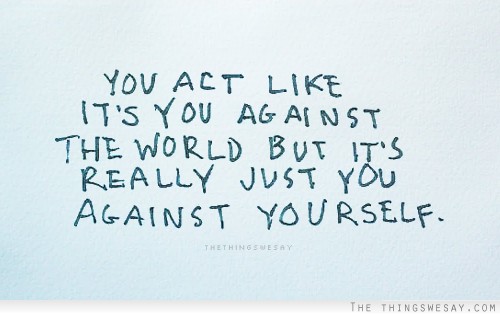
I’ve learned the statement at left the hard way. Through years of trying to “take on” the world, I have realized, we all fight a battle with ourselves. To solidify my claim that it was “me against the world” I had the lyrics to a song tattooed on my arm. As I have grown older and wiser, I realize this couldn’t be further from the truth. It is not the world that becomes the enemy but an enemy we know all too well…ourselves.
I believe in a very simple equation; “Thought plus decision equals behavior, change the thought, change the behavior.” This to me makes me a believer that if we just alter our thinking, we can alter our behavior. Thus we can accomplish anything we set out to do. It is not the physical gifts nor the outstanding acumen that separates people from one another, it is the sheer will to conquer one’s self on a quest of a goal or idea.
So many times I have seen clients succumb to their own negative thoughts in their head that they quit and never try again. They listen to that voice in their head that tells them its not possible or that it cant be done. It eats at them until the thoughts impose their will and cause them to stop chasing their dream or ideal. It truly becomes a mental game of chess between you and yourself. Deciding who to listen to will ultimate decide who the winner is. Here are a few tips to conquering self doubt and negative thoughts.
1. Get rid of negative people- Regardless of who you are, you will always have negative people around you. Telling you, you can’t do something, bringing your down to their level. Do not let them. Rid them of your life, if at all possible or limit your contact. Never let someone tell you, you can’t do something.
2. Surround yourself with positive people who make you better- This may only be one person or it may be many but you need at least one. Someone who positively empowers you will only make your life better. This could be a parent, a sibling or a trainer (like JB).
3. Realize your thoughts create your reality- What you think is always true. If you think you are no good, you will be no good. Your actions will emulate your thoughts. Your thoughts become your reality. Flip the thoughts from negative to positive and works the same way.
4. Right a list of positive things about yourself and post it where you can see it- This is a technique that will work wonders and will remind you that for all your faults and all the bad experiences, the good will always outweigh the bad.
5. Stop making excuses- Stop using the past as deterrent for the future. What happened back there happened back there, its over. It doesn’t predict what happens tomorrow.
Me Against the World? Never, its you against you and you get to decide who wins.
By John Y. Brown III, on Wed Oct 30, 2013 at 12:00 PM ET
Point, Counterpoint: a deep philosophical debate with Rene Descartes (dead) and John Brown (not dead but bored and wasting time on a frivolous post.)
Mr. Descartes will go first:
“I think, therefore, I am”
–Rene Descartes
John Brown on rebuttal:
“Sure. That sounds really smart at first, but come on. Really? I mean….it doesnt even stand to reason. For example, some people think too much. That doesnt mean they exist too much, right?
Other people only think sometimes. We don’t say they only exist sometimes.
Do we? I don’t.
And some people dont think at all, but still exist and continue to show up at family reunions. I know this for a fact. I was one of them for about 18 months in the early1980’s and still got invited to and attended a family reunion.
Maybe a better formulation could be, “I got invited to attend my family reunion, therefore, I am.” But then what about those living in cultures that don’t celebrate family reunions or families where the family member who usually hosts the family reunions has had it and finally says “I am not doing this anymore. I am sick of all you ungrateful jerks. Let someone else have it at their house next time.” This happens. A lot. What about them? They still exist, right.
Maybe Descartes would have made his point more validly by saying, “I sometimes try to sound like a know-it-all by saying things that sound really profound even though they really aren’t, therefore I am irritating and get on people’s nerves.”
If Descartes had gone with this formulation, I doubt anyone would have challenged him and we wouldn’t even be having this debate right now.
And I didn’t even have to think too hard to completely disprove Descartes’ theory. And that is pretty cool– whether or not I can prove I exist.


 Blog this!