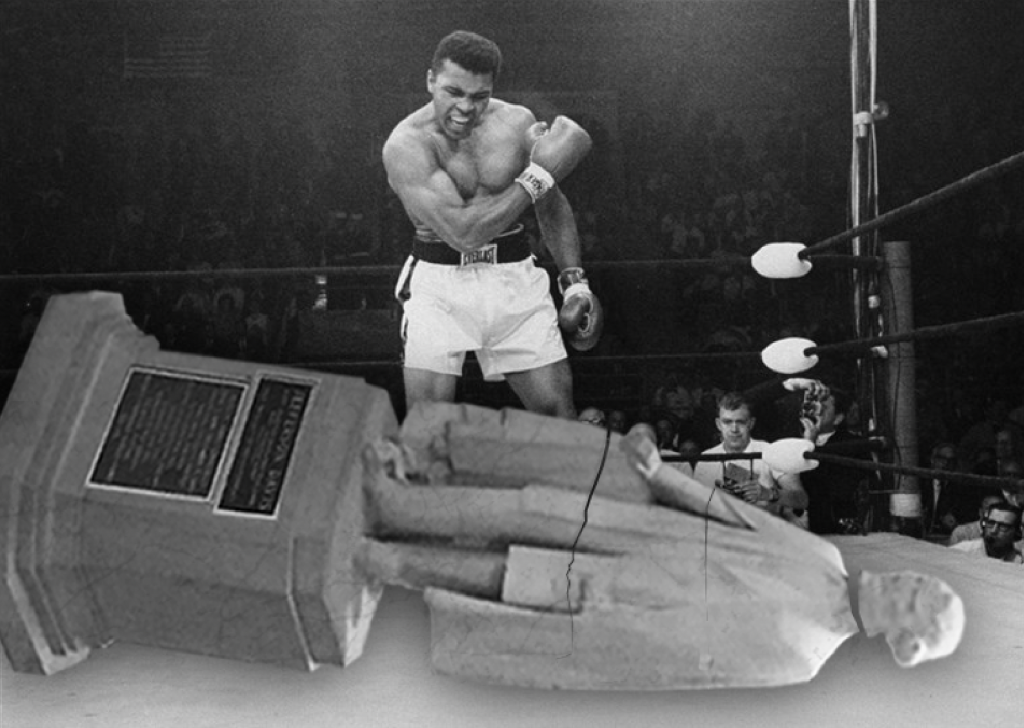
Please sign the petition below to remove the statue of Jefferson Davis currently in Kentucky’s Capitol Rotunda, and replace it with a tribute to Muhammad Ali, “the Louisville Lip” and “the Greatest of All Time.”
I just heard from the Ali family: It is the Champ’s belief that Islam prohibits three-dimensional representations of living Muslims. Accordingly, I have adjusted the petition to call for a two-dimensional representation of Ali (a portrait, picture or mural) in lieu of a statue.
UPDATE (Tuesday, December 2, 2014)
In this interview with WHAS-TV’s Joe Arnold, Governor Steve Beshear endorses the idea of honoring Muhammad Ali in the State Capitol (although he disagrees with removing Davis). Arnold explores the idea further on his weekly show, “The Powers that Be.”
Click here to check out WDRB-TV’s Lawrence Smith’s coverage of the story.
And here’s my op-ed in Ali’s hometown paper, the Louisville Courier-Journal.
UPDATE (Saturday, June 4, 2016)
In the wake of the 2015 Charlestown tragedy, in which a Confederate flag-waving murderer united the nation against racism, all of the most powerful Kentucky policymakers — U.S. Senator Mitch McConnell, Governor Matt Bevin, Senate President Robert Stivers and House Speaker Greg Stumbo — called for the removal of the Davis statue from the Rotunda. Today, as we commemorate last night’s passing of Muhammad Ali, there is no better moment to replace the symbol of Kentucky’s worst era with a tribute to The Greatest of All Time.
UPDATE (Wednesday, June 8, 2016):
Great piece by Lawrence Smith of WDRB-TV in Louisville on the petition drive to replace Jefferson Davis’ statue in the Capitol Rotunda with a tribute to Muhammad Ali.
UPDATE (Thursday, June 9, 2016):
Excellent piece on the petition drive by Jack Brammer that was featured on the front page of the Lexington Herald-Leader.
Highlight of the article:
Miller said he has received a few “angry comments” on his call to honor Ali.
“One of them encouraged me to kill myself,” he said. “You can quote me that I have decided not to take their advice.”
UPDATE (Friday, June 10, 2016)
The petition drives continues to show the Big Mo(hammed): check out these stories from WKYU-FM public radio in Bowling Green and WKYT-TV, Channel 27 in Lexington:
UPDATE (Saturday, June 11, 2016):
Still not convinced? Check out this excerpt from today’s New York Times:
By Kristen Hamilton, RP Staff, on Mon May 30, 2011 at 4:00 PM ET
At a very young age, my grandfather, Charles Hamilton, fought in the Korean War.
My grandfather never said much about the war, but he did tell the family about the time his comrade accidentally shot him in the foot after which he would always chuckle. I doubt that my grandfather knew that he was my hero, but he was. Even though he is no longer with us, his legacy continues to live on.
Both our fathers, Harry Greissman (who died in 1997) and Kent P. Hollingsworth (who died in 1999), proudly served in the U.S. Army.
Their service was a decade apart.
Harry Greissman
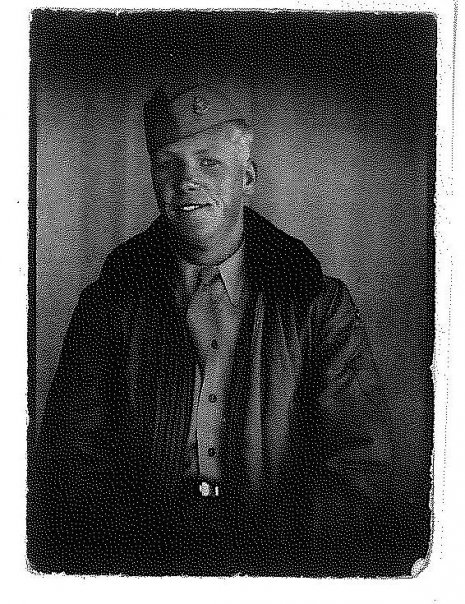
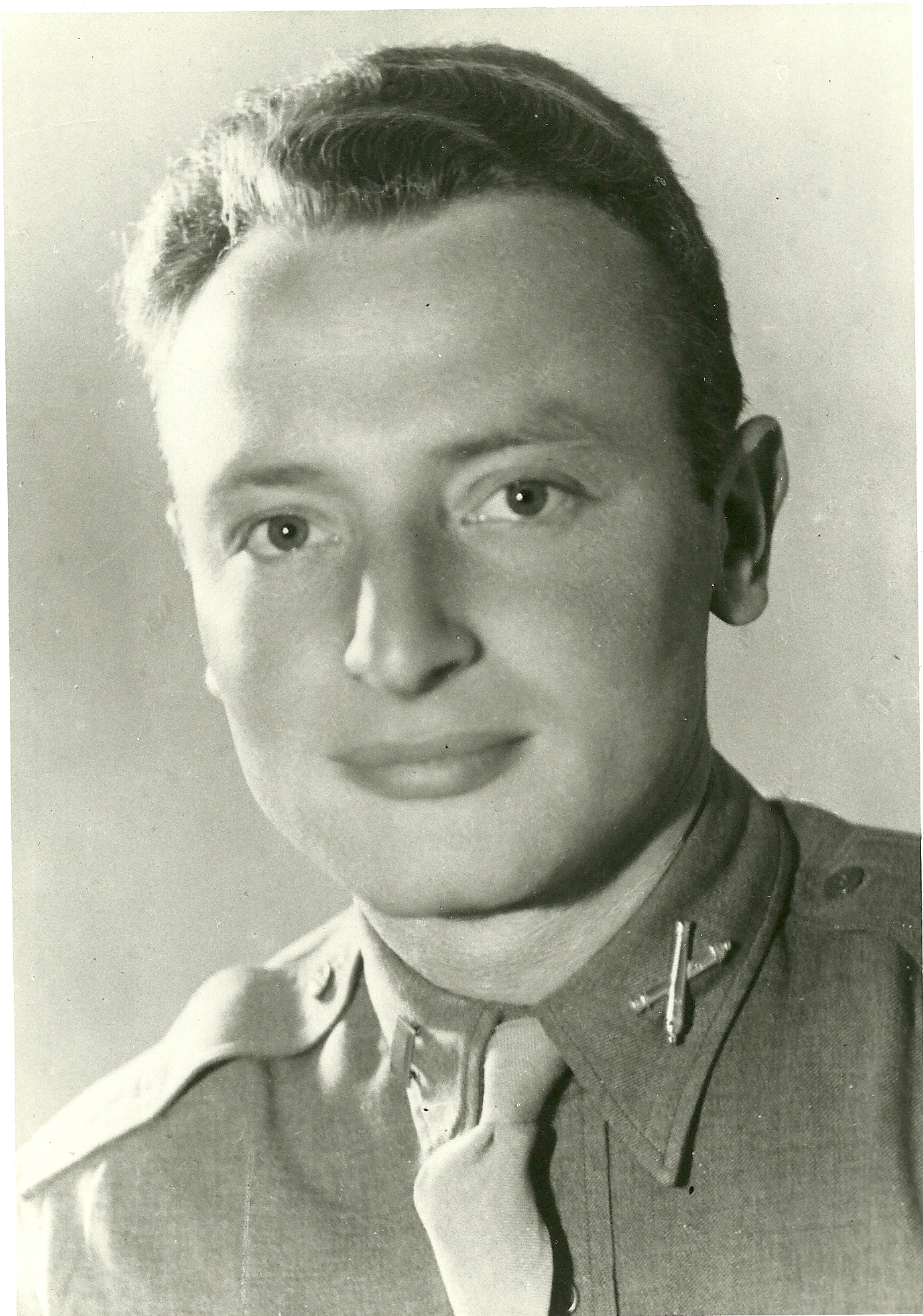
Harry Greissman was from Brooklyn, New York and served as a lieutenant in the Seventy-eighth (Lighting) Division during World War II.
His letters to a Southern sweetheart Anne Hetrick describing the European Front and the horrors of that war have been immortalized in the book, LOVE STORIES OF WORLD WAR II, compiled by Larry King.
Kent Hollingsworth grew up in Scott County, Kentucky, and followed his older brothers’ example by enlisting in the Army. In 1952, he graduated from Armored Officer Candidate School at Fort Knox and served as a tank gunnery instructor, close combat instructor, trial judge advocate for regimental special courts martial, resigning from active reserves as a captain in 1962. For the next 23 years Hollingsworth served as editor of the Blood-Horse, a weekly magazine devoted to Thoroughbred racing and breeding, and his eloquent writing remains a model few can master.
Both men could light up a room with their wonderful humor and captivate us all with their spellbinding way of telling a story. Both married beautiful women who knew how to throw a great party. We miss them terribly, and yet we are comforted knowing that they were – and are – our heroes.
My tribute is to my grandfather. He fought in WW-I; he was a combat engineer, like me. His job was to infiltrate Axis lines to destroy bridges eliminating the opportunities to either evacuate or reenforce the front upon attack by the allies.
When he’d finished he messengered success to Command. He was ordered to hide in place. After the successful attacks to break the Axis, he was ordered to begin rebuilding those bridges.
By Ronald J. Granieri, on Mon May 30, 2011 at 2:30 PM ET
My Godfather, Bill Mellan, had an easy smile and a big laugh. He was instantly likeable, and was a loving father to his boys as well as a devoted husband to the love of his life, my Godmother Mary Jean.
He was also a veteran of the Battle of the Bulge, who had received the Bronze Star for bravery. I heard this last fact not from him but from my mother. Uncle Bill was much too kind and self-effacing to puff himself up with tales of military glory. I never heard him talk about his war experiences, and am under the impression that he kept the stories of his heroism to himself. That kind of quiet heroism is valuable and rare in a society where too often people cannot rush to a microphone fast enough to tout their latest insignificant accomplishment, and it just one reason why I admire him.
I am not a big fan of the propaganda about “the Greatest Generation,” which strikes me as too much Baby Boomer self-regard masquerading as filial piety, as if praising their parents now will make up for the awful things they said about them back in the 1960s. But I have nothing but respect and praise for those who did serve, and who, after doffing their uniforms, returned to build American society as loving husbands and fathers and hard working friends and neighbors. Those are true heroes. People like my Uncle Bill.
By Zack Adams, RP Staff, on Mon May 30, 2011 at 2:00 PM ET
I consider myself extremely fortunate to have had two grandfathers that both served their country proudly. Both of them taught me so much about life and how to be a gentleman and a real man.
Our Memorial Day serves as a great reminder of the parts of their lives they sacrificed for our country. Even though they both served in active combat they survived to live long lives and carry the scars of battle through civilian life until their respective deaths.
Clyde and Nancy Adams
My dad’s father, Clyde Adams, was a career soldier in the U.S. Army. Throughout her career he was stationed all over the world: Germany, Panama, and here in the U.S. at Fort Bragg in North Carolina. He fought in two tours of duty in the Vietnam conflict and served as a quartermaster. He also spent time as an Army paratrooper. He often wondered aloud later in life why someone decided to jump out of a perfectly good airplane. My grandfather retired at an early age at the rank of Master Sergeant. He was offered a promotion to Sergeant Major, but was eager to enter retirement and spend more time with his family (his wife and son). He was awarded a Bronze Star and a Purple Heart. He passed away at the age of 65 on December 21, 1999.
Leon Ferguson
My mom’s father, Leon Ferguson, served two tours of active combat during World War II. Instead of waiting for his name to be called during the draft he volunteered to join the U.S. Army. He fought in France, Germany, and Luxembourg specifically. I’m sure I’m leaving some out, but those of the particular ones that I can remember from conversations. He fought Nazis and he survived. He served one three year tour, was injured, and came home, only to go back for another three year tour. My grandfather volunteered at the age of 17, knowing he would enter into one of the violent wars in history, unbelievable. And yes, he was on the beach in Normandy. He obtained the rank of Private First Class and was awarded the Bronze Star and two Purple Hearts. He passed away at the age of 83 on Feb 14, 2006.
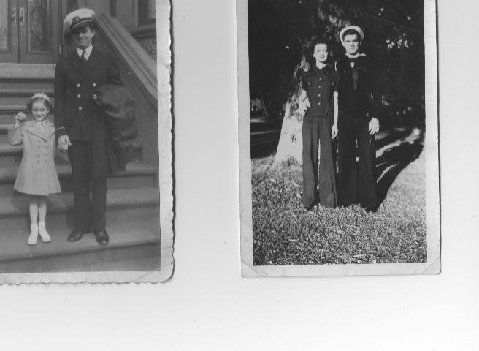
My father was a Pearl Harbor survivor. (The picture at left is of me and my father; He stands with my mother on the right).
He joined the Navy in 1936 as an enlisted man he retired as a Commissioned Warrant Officer in 1957.
He was born in Winchester, Kentucky on April 2, 1917. Both of his brothers served in the military: my Uncle Cecil in the Navy, my uncle B. B. in the Army Air Corp.
He was on the USS McDounagh at Pearl Harbor on December 7, 1941. My mother and I were in San Diego, I was 7 months old. My mother didn’t know if he was alive or dead for 10 days.
I was born second in line behind my older brother, Ricky. He was 3 and 1/2 years older than me.
Early on, sibling rivalry developed between us. I always wanted to tag along with Ricky and his friends but being as much younger as I was, they didn’t want me around.
At one point, Ricky and his friends formed a Yankees fan club. I really wanted to be part of it only to once again be denied. That year, the Yankees played the Pittsburgh Pirates in the World Series. Since I couldn’t be in the Yankees fan club, I rooted for the Pirates. The Pirates won the series and I became a fan for many years.
Ricky went away to a Catholic seminary for his first two years of high school. In spite of our sibling rivalry, I found myself missing him at times. When he came home, though, the sibling rivalry resumed. As I had developed my own circle of age appropriate friends, the intensity of the rivalry was far less.
When I started my first year at Catholic high school seminary in Missouri, Ricky was in his senior year at local Catholic high school in Louisville. I was homesick at times.
With the Thanksgiving holiday coming up and many of the local St. Louis area boys going home to be with their families, the homesickness was particularly intense. Ricky took the Greyhound and came to visit me over that weekend. His visit meant the world to me. The bitterness of the sibling rivalry was completely dissolved over that weekend.
After graduating from high school, Ricky began a job as a union sheet metal
worker. The Vietnam War was going full tilt by then. Ricky, being the young patriotic man that he was, felt very strongly that he needed to serve his country. In the fall of 1967, he enlisted in the Marine Corps. The following spring, he came home to Louisville before shipping out to Vietnam. I had to get special permission to leave the seminary to visit home before Ricky left. The time of the visit flew by and Ricky took me back to airport to fly back to St. Louis. He walked with me to the tarmac. As I reached the top of the stairs to the plane, I turned to wave goodbye to him.
Our eyes locked and I immediately knew that I would not see him again. I
remember going to my seat with tears in my eyes and a stewardess asking me if I was okay. “Yes,” I said “I just said goodbye to my brother who’s going to Vietnam.” I didn’t tell her what provoked the tears.
On June 15th , 1968, just 10 days after the assassination of Robert Kennedy, one of Ricky’s heroes, Ricky was killed in action in Quan Tri Province, Vietnam. It was the day before my 16th birthday. On Tuesday, June 18th, I was standing on our front porch with some friends when the Marine Corps car pulled into the driveway. My heart sank and there was a pain in the pit my stomach. I knew why they had come and that our lives were never going to be the same.
My mother, Lois Howard was a lieutenant jg in the Navy. She was stationed in Washington in the Office of Naval Intelligence.
One of my mother’s favorite stories was of walking back from night duty almost at sunrise in Washington, where she sometimes ran into President Harry Truman, who was out on his morning walk. Mother reported that Truman would greet her with a salute, saying, “Good morning, Lieutenant!” This was before the assassination attempt on Truman’s life, when he was accompanied by only one or two bodyguards.
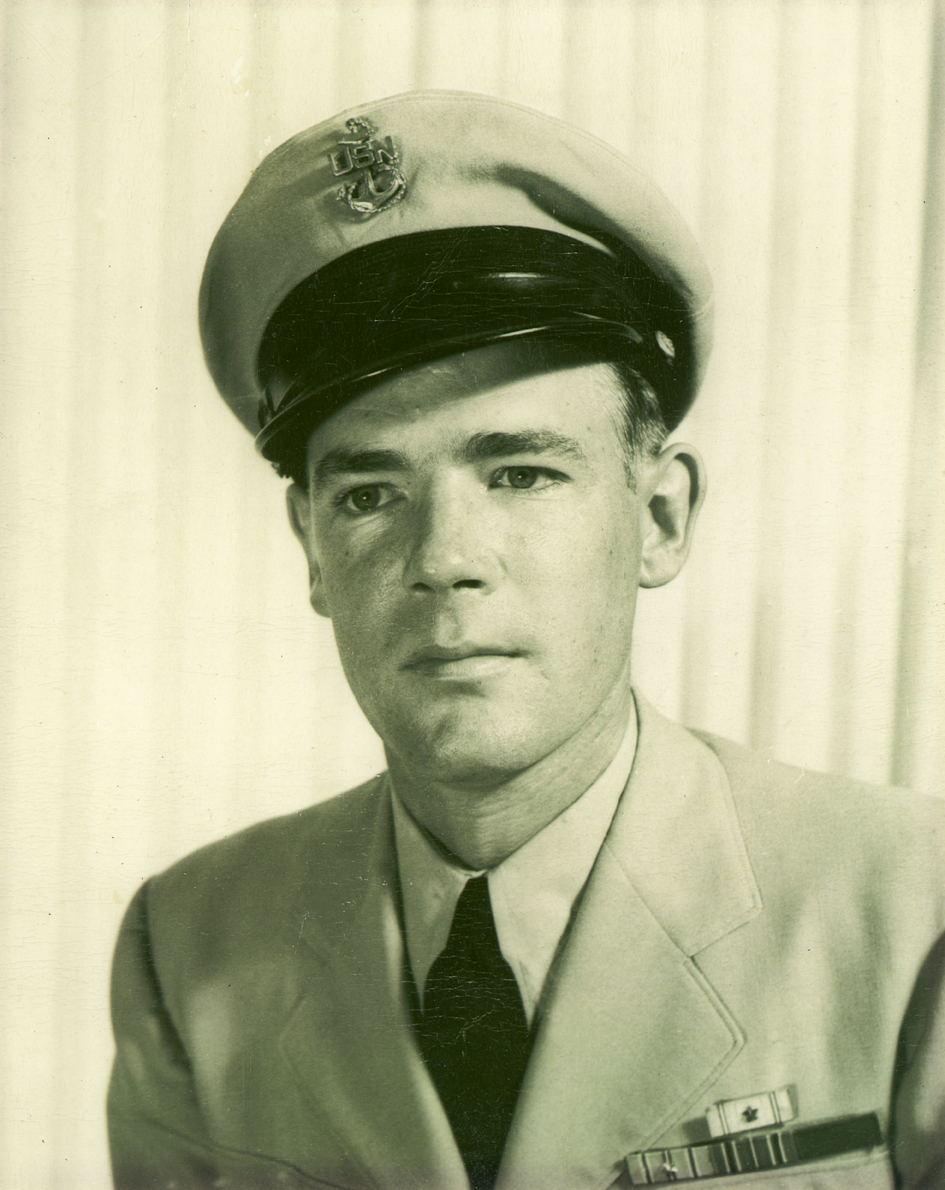
My father, James Norris Gray (1917-1972) was a chief petty officer, and spent his tour of duty in the Pacific on a PT boat, and in China.
Editor’s Note: The author, Jim Gray, is the Mayor of Lexington, Kentucky.


 Blog this!