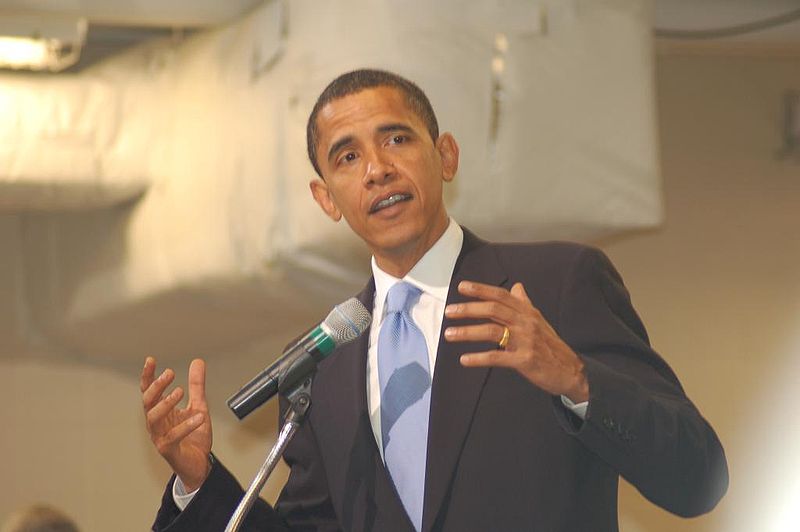
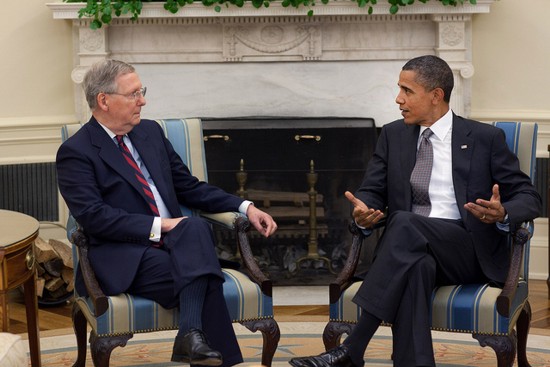
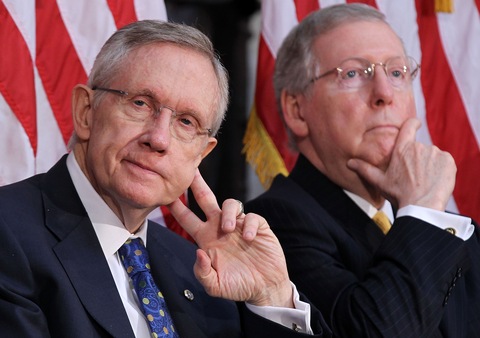
By Patrick Derocher, on Mon Aug 1, 2011 at 9:30 AM ET President Obama took to the White House briefing room at 8:40 p.m. Sunday to announce that an agreement had been reached on the debt ceiling. President Obama and Congressional leaders have come to a compromise to avoid defaulting on the country’s loans and cut government spending. The two-step deal, which has been approved by Senators Harry Reid and Mitch McConnell Speaker John Boehner (but not yet Representative Nancy Pelosi), begins with the Boehener plan of $917 billion in cuts coupled with a $900 billion debt ceiling increase. This includes an immediate $400 billion increase through September and a later $500 billion increase, with Congress voting on resolutions of disapproval, which the President can subsequently veto. The second stage involves “Super Congress” cutting spending by $1.5 trillion by November, with a vote by the end of the year, at the peril of automatic across-the-board cuts. [CNN]
Even though a debt deal has been worked out, and many Republicans are pleased with the Speaker’s ability to reach a compromise, there are many in the House Republican Caucus, including many Tea Party-affiliated members, who have derided the bill as not going far enough. The challenge, now, is for John Boehner and House Minority Leader Nancy Pelosi to rally enough votes from their respective parties to pass the deal in spite of the flanks. [Politico]
On the other end of the spectrum, progressive members of Congress are taking issue with the deep cuts, including the possibility that Social Security, Medicare, and Medicaid may be on the chopping block if the 12-member board reviewing deficit cuts fails to reach a deal. In particular, Representatives Emanuel Cleaver of Missouri and Raul Grijalva of Arizona, who chair or co-chair the Congressional Black and Progressive Caucuses respectively, have already signaled that they do not plan to support the plan, and Nancy Pelosi was cautious with her support as of Sunday night. [Roll Call]
Even though the agreed-upon bill does not include any specific provisions to increase revenues, President Obama has said that the Bush tax cuts are included in the trigger, meaning that failure by the Super Congress to reach a deal by Thanksgiving will result in their repeal. [Huffington Post]
John Boehner used a PowerPoint presentation to sell the Obama-McConnell deal to his caucus on Sunday. Here it is. [National Journal]
The Washington Post provides a handy graphic illustrating which parties got and gave up what in reaching the deal being presented to Congress on Monday. [Washington Post]
With the House Republican caucus clearly split on whether or not to vote for the Obama-McConnell plan, all eyes are on House Minority Leader and former Speaker Nancy Pelosi of California. Pelosi, who has not specifically endorsed the deal as of Monday morning, also faces a caucus rife with division and distaste for the bill (though probably not as deeply divided as the Republicans), and the bill will not pass without some House Democrat support. In recent days, Pelosi and other senior Democrats have advocated for President Obama to invoke provisions of the 14th Amendment and raise the debt ceiling without asking (or waiting) for Congressional approval. [The Hill]
Following the announcement of a debt deal, markets in Tokyo, Seoul, and Hong Kong gained between 1 and 2 percent apiece while Dow Jones, NASDAQ, and S&P 500 futures all climbed by about 1 percent. Additionally, gold prices, which were expected to climb in the event of a default, dropped after rising steadily for years to an all-time high. [National Journal]
It’s still early, but there already whip counts for the Obama-McConnell bill. The Hill lists 13 in favor, 6 opposed, and several hundred unknown, and Republican Senator Mike Crapo of Idaho has said that he expects some 35 Republican senators to sign on to the Obama-McConnell deal announced last night. [The Hill]
By Patrick Derocher, on Sun Jul 31, 2011 at 4:01 PM ET Following the failure of the Reid bill in the Senate on Sunday, the plan currently being worked on by President Obama and Sen. McConnell is the last major budget plan on the table. The Atlantic provides a useful overview of the state of budget negotiations now that the Obama-McConnell plan, nebulous though it may be at this point, is the only budget plan (apart from the Gang of Six’s much maligned “Back in Black”) on the table in Congress. [The Atlantic]
More details are emerging about the Obama-McConnell debt reduction plan, including increased powers being granted to “Super Congress,” a bipartisan, bicameral council of 12 lawmakers who will have to make spending cut recommendations by Thanksgiving or face automatic, across-the-board spending cuts. This body has been demanded by Republican lawmakers, though Democratic leadership has only recently agreed to its existence. Neither the Tea Party nor the left wing of the Democratic Party is fond of the notion, as Tea Party factions believe it raises the possibility of increasing the debt whilst some Democratic groups balk at the notion that its actions may lead to deep, even automatic, cuts in Medicare, Medicaid, and Social Security. [Huffington Post]
The Reid plan for debt reduction failed in the Senate, leaving the fate of the Obama-McConnell plan somewhat in question, especially given Speaker Boehner’s difficulty in rallying his caucus behind previous plans. [Talking Points Memo]
According to Gene Sperling, Director of the National Economic Council, there are three provisions that must be in a final budget deal for President Obama to support it: That the bill include a “significant down payment” on the US’s debt, that revenues be part of a final plan, and that uncertainty be removed from the market. Although the plan as it is believed to exist includes only spending cuts, Obama Administration officials, most notably David Plouffe, insist that any recommendations by the “Super Congress” will be their nature have to include revenue raisers. [Roll Call]
Tea Party activists are exhibiting increasing displeasure at the House Republicans’ willingness to compromise on debt and budget concerns, with some taking issue with the fact that a debt ceiling increase has been approved at all. As in 2009, many of these groups have threatened incumbent lawmakers, even those who were elected with Tea Party support, with primary challenges. [Politico]
Although the Senate is technically in recess at the moment, Majority Leader Harry Reid has told Senators not to stray too far from the chambers, indicating the possibility that they will vote on the Obama-McConnell plan in the near future. In a tongue-in-cheek move, the Nevada Democrat said “I would not suggest a ball game” (Nationals Park is barely a mile from the Capitol). [The Hill]
Possibly in an effort to assuage liberal activists, President Obama and his administration have said that they will continue to push for revenue raisers, including repealing the Bush tax cuts, in spite of the fact that the Obama-McConnell plan does not explicitly include anything other than spending cuts. The administration’s plan includes using the cuts’ 2012 expiration as a sort of trigger to increase revenue increases, with the President possibly utilizing a veto after the election even if he loses. [Washington Post]
By Patrick Derocher, on Sun Jul 31, 2011 at 11:00 AM ET A constant presence at the bargaining table, Chuck Schumer has been an important voice in budget negotiations. Appearing on CNN Sunday morning, Mitch McConnell said that he and President Obama were “very close” to reaching an agreement on the debt ceiling. According to the Kentucky Senator, the deal would be a two-step process involving an immediate increase in the debt ceiling, a vote on the Balanced Budget Amendment, and a bipartisan committee to recommend spending cuts. [CNN] and [Washington Post]
According to former Moody’s Analytics economist Mark Zandi, the debt deal supposedly being worked out by the President and Republican members of Congress should be sufficient to avoid a credit downgrade for the United States. He did, however, admonish that if this deal breaks apart, it would plunge the country back into recession. [Politico]
Even as the House and Senate rejected or tabled each other’s bills Friday and Saturday, talks on Sunday rekindled hopes that a substantive bipartisan deal may still be possible. In particular, Chuck Schumer, Democrat of New York and Senate Majority Whip, said that while a final deal has not been worked out yet, there was a sense of “relief” in the Capitol Sunday morning. Recognizing that Democrats had compromised on some aspects of a budget bill, Schumer took pride from the fact that the Senate had kept at bay more drastic Republican measures, namely Paul Ryan’s budget. [Huffington Post]
Senior adviser to President Obama David Plouffe has said that, while there is no final deal in place between the President and Congressional leaders, a final deal could include provisions for $4 trillion in debt reduction by 2013. He has also said that, while there are no revenue increases in the first stage of the deal, the bipartisan committee charged with cutting further money from the deficit would have to include such measures in their recommendation. [Politico]
South Carolina Republican Senator Lindsey Graham, who himself has said he will not vote for the bill being worked on by President Obama and Congressional leaders, does not believe that more than about half of the House Republican Caucus will vote for that plan. Citing the possibility of increasing the country’s debt by $7 trillion, Graham expressed skepticism that Speaker Boehner would be able to sell the plan to House Republicans. [The Hill]
The Atlantic, as always, has some of the best quick analysis of what the rumored deal means, the pros and the cons: [Atlantic Wire]
By Patrick Derocher, on Sat Jul 30, 2011 at 2:00 PM ET Harry Reid is hoping to pass his bill with bipartisan support by adding elements from proposals by Mitch McConnell. After a provision for the Balanced Budget Amendment was added at the last minute, the third iteration of Speaker Boehner’s debt bill passed the House 218-210, with all Democrats and 22 Republicans voting against it. Within only two hours, the Democratically-controlled Senate tabled the measure in a 59-41 vote that saw all 51 Democrats, 2 Democratically-aligned Independents, and 6 conservative Republicans vote against the measure. The Senate returned to session at 1 p.m. Today and a vote on Majority Leader Reid’s plan is expected around 1 a.m. Sunday morning. [Washington Post]
Among the 28 Republican “nays” between the two houses of Congress, seven came from the entirety of the South Carolina delegation. (Of the state’s six Representatives and two Senators, only House Assistant Minority Leader James Clyburn is a Democrat.) This move came as a result of the conservative lawmakers pushing for a Balanced Budget Amendment and deeper spending cuts than had been provided in the Boehner bill. [National Journal]
As of Friday morning July 29, Apple Computer has more cash on reserve than the Federal government- Apple’s $75.88 billion to the Treasury’s $73.77 billion. [MarketWatch]
Skipping Social Security payments has been floated as a possible response if Congress fails to come to a final deal on the debt ceiling. Outside analysis, however, has shown the possibility that doing so will unleash a “domino effect” of missed payments and pursuant interest rate hikes, especially among elderly women. [Huffington Post]
In a plan sent to Talking Points Memo, Senate Majority Leader Harry Reid put together what may be his final debt deal to Senate Republicans, designed to bring as many as possible on board to convince the House to pass the bill. Included are deeper spending cuts, to approximately $2.4 billion, and a provision, drawn from Minority Leader Mitch McConnell’s plan, to give President Obama the authority to raise the debt ceiling subject to Congressional disapproval. [Talking Points Memo]
Using evidence from budget impasses and government shutdowns from the 1980s and 1990s, some veteran lawmakers and experts on the Congressional process are skeptical about the possibility that any debt deal will be reached within that body by August 2. In particular, former Senate Majority Leader Tom Daschle has come out saying the thinks a deal may not arise in time. [NY Times]
By RP Nation, on Sat Jul 30, 2011 at 8:34 AM ET
By Grant Smith, RP Staff, on Fri Jul 29, 2011 at 3:00 PM ET
The United States Supreme Court should invalidate patents for software. [Forbes]
Day-traders: how to trade a potential U.S. bond downgrade. [The Street]
Blackberry, once the status symbol of the business world is now fighting for its life. [CNBC]
The Forbes family’s dealings could spell disaster for their famous media brand. [Fortune]
Deficit cutting will widen the retirement gap for minorities. [Reuters]
By Stephanie Doctrow, RP Staff, on Fri Jul 29, 2011 at 12:00 PM ET Trying to eat less? Experts say using a bigger fork can make a difference in how much you eat. [Time]
Walter Reed Medical Center, a hospital that saw multiple wars and decades of history, will be closing in August. [NY Times]
Medical officials were once worried about caring for crack-addicted babies, but now more and more children are born addicted to prescription drugs. [CNN]
Would you like a side of apple slices? That’s the newest addition to Happy Meals, in an attempt to make them healthier for kids. [Wall Street Journal]
Here’s scientific proof on why we eat our feelings when we’re down. [Huffington Post]
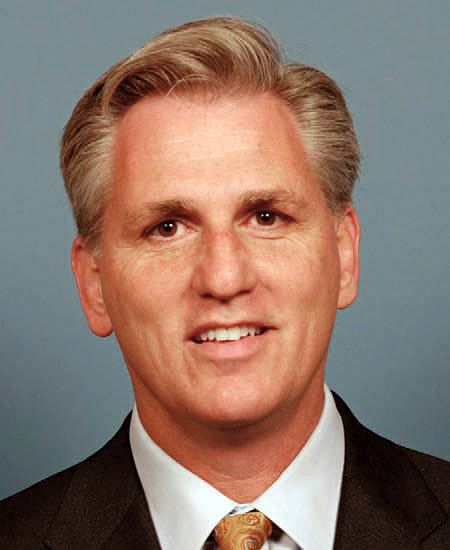
By Patrick Derocher, on Fri Jul 29, 2011 at 9:30 AM ET House Majority Whip Kevin McCarthy (R-Calif.) worked with Speaker Boehner to obtain votes for his ultimately delayed budget vote until late last night. There was one major development in the Budget Crisis yesterday: Nothing happened. After a vote originally scheduled for 6 p.m. was delayed several times, Republican leadership announced at around 10:30 that no vote would be taken on Speaker Boehner’s debt-reduction plan until Friday at the earliest. Republican leadership had been having difficulty, highly publicized, rounding up a sufficient number of “yes” votes from the Republican Caucus to pass the bill with no Democratic support. [The Hill]
On the up side, New York-based analyst Brian Gardner, who works for a boutique investment bank in that city, theorizes that threats to lower the United States’s credit rating under certain circumstances even if the debt ceiling is raised may be a bluff. According to his analysis, some level of “enforceable cuts” with an appropriate debt ceiling increase would avert the downgrade. [Huffington Post]
Democratic congressional leaders are floating the idea of a compromise bill that they hope will be amenable to House Republicans. According to the plan, the debt ceiling increase would still be in two steps, but the second raise would not be contingent upon the findings and recommendations of a panel dedicated to cutting the deficit. [Politico]
House Minority Whip Steny Hoyer of Maryland became the highest-ranking Democrat to call on President Obama to raise the debt ceiling unilaterally if a deal is not reached in time for the August 2 default deadline. The President’s authority to do this is said to derive from the 14th Amendment, which says that the validity of the US’s public debt shall never be called into question, though Congressional powers derived from Article 1 muddy the issue some. [Huffington Post]
Adding urgency to budget negotiations, at least over the long run, a study from Medicare economists has come to the conclusion that by 2020, healthcare costs will hit $4.6 trillion, or one-fifth of the American economy. At that point, per capita health spending is estimated to be at $13,710. [Huffington Post]
By Zack Adams, RP Staff, on Thu Jul 28, 2011 at 3:00 PM ET
Tomorrow, the Obama administration will announce the the compromised fuel economy standards set to take effect in 2025. The original goal was to make the standard 56.2 mpg, however that number was met with opposition from several automakers. The compromise is by the year 2025 54.5 mpg will have to be the average of automaker vehicles. This is all-things-considered a good step for fuel conservation and the environment. [Reuters]
Those of you who are Chrysler fans will be happy to hear that even though the company is merging with the Italian automaker Fiat, CEO Sergio Marchionne has recently confirmed that Chrysler will remain American. [The Detroit News]
Due to the recent earthquake in Japan, Toyota has lost its hold on the global sales lead. At the half-year mark it has been overtaken by the Volkswagen Group and Renault-Nissan. Once, General Motors release their figures they are expected to take the lead. Of course, Toyota’s slip is only due to the natural disasters. [Go Auto]
Although Ford was the only Detroit automaker to avoid bankruptcy after 2009, they still lag behind others in Asian markets. That is why they are investing $1 billion to build production plants in India. [NY Times]
By Robert Kahne, RP Staff, on Thu Jul 28, 2011 at 2:00 PM ET
I’ve worked in the field of higher ed sustainability for several years now. Many of my colleagues, when asked to identify the main hurdle towards sustainability in existence today would respond with “America’s consumerist culture.” Not a bad answer, at first glance. Just looking around my room, I see dozens of items which I don’t use and indeed, many which I have NEVER used–and I’m supposed to be the sustainable one! It is not usual at all for American families to have 2 cars, 3 televisions, and a computer for every person in the house. Lots of people out there want to rethink this, especially in face of the facts such as “the useful life of a power drill is about 4 minutes.” and “there is a portion of the Pacific Ocean filled with plastic which is twice the size of Texas.” To fight this problem, people have set up system of “sharing” in which several people will buy 2 cars, or 1 vacuum cleaner, or one washer/dryer set, and share amongst themselves. People have even reformed their libraries so that if you need a power drill, you can check it out like you would the most recent George RR Martin book. A good idea, right?
The Great Pacific Garbage Patch Its true, it takes a lot of energy and carbon emissions to make a lot of the stuff that we don’t use, and it is further true that increased carbon emissions are heating the planet to the point that the world will likely become something none of our grandparents would recognize by the time we are dead. Ergo, reducing our consumption of stuff and sharing makes sense, right? As is true with everything, nothing is quite that simple. Our economic system is a complex system of purchases–purchases of big things like cranes and roads and tanks; purchases of important things like labor and art and food, and yes, even purchases of junk like McDonald’s toys and plastic spoons and cheez-its. When a piece of this consumption train breaks down, it causes all sorts of economic pain and suffering. In a piece published last Saturday in the New York Times Sunday Review, David Leonhart examined the effect which falling consumer purchases have prolonged the economy. His conclusion was that the old, consumerist economy, was dead; we need to build “an investment and production economy, with rising exports, expanding factories and more good-paying service jobs.”
 Image from NYT article Okay, that’s fine, but if we build one of these “investment and production economies” and shy away from the debt which helped us to build this huge consumption bubble, don’t we still need people to export to, and people to buy the things we make in these new factories? Don’t we need people who sell things to spend their money in places where these “good paying service jobs” still exist? I know that Leonhart is not making a case for sustainability in his article, but I think the solution he posits in his article still keeps relatively the same system in place which created the consumer problem in the first place: in order to create growth, stuff needs to be sold. Paradoxically, the more stuff that gets sold, the worse off the world is.
Read the rest of…
Sustainability and Consumerism
|
The Recovering Politician Bookstore
|