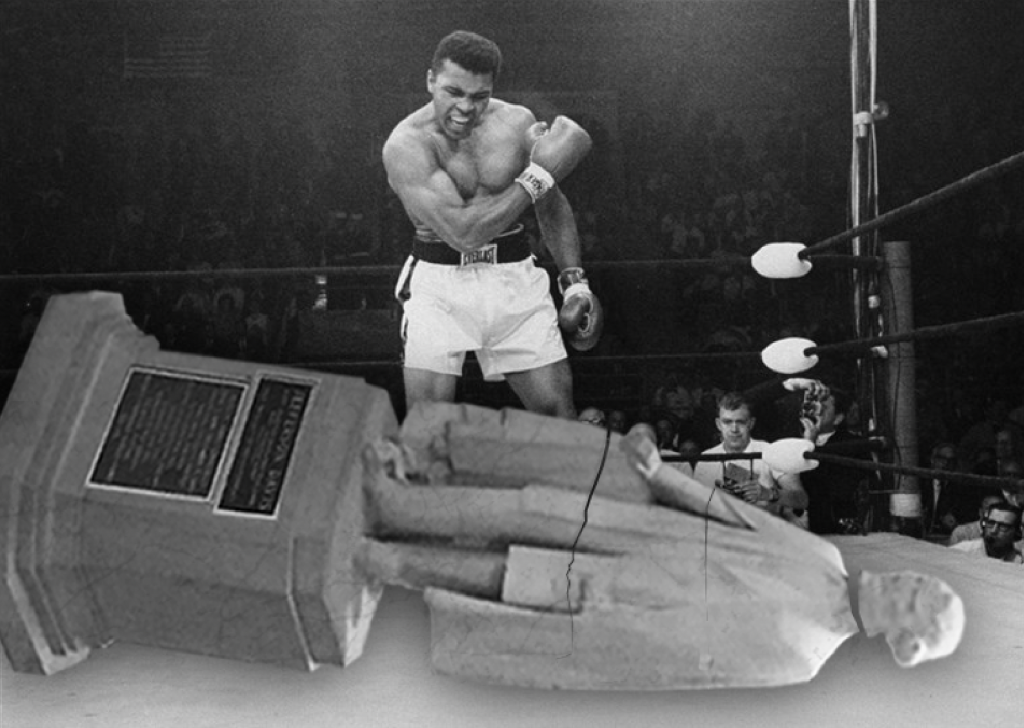
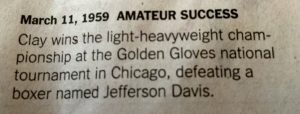
Please sign the petition below to remove the statue of Jefferson Davis currently in Kentucky’s Capitol Rotunda, and replace it with a tribute to Muhammad Ali, “the Louisville Lip” and “the Greatest of All Time.”
I just heard from the Ali family: It is the Champ’s belief that Islam prohibits three-dimensional representations of living Muslims. Accordingly, I have adjusted the petition to call for a two-dimensional representation of Ali (a portrait, picture or mural) in lieu of a statue.
UPDATE (Tuesday, December 2, 2014)
In this interview with WHAS-TV’s Joe Arnold, Governor Steve Beshear endorses the idea of honoring Muhammad Ali in the State Capitol (although he disagrees with removing Davis). Arnold explores the idea further on his weekly show, “The Powers that Be.”
Click here to check out WDRB-TV’s Lawrence Smith’s coverage of the story.
And here’s my op-ed in Ali’s hometown paper, the Louisville Courier-Journal.
UPDATE (Saturday, June 4, 2016)
In the wake of the 2015 Charlestown tragedy, in which a Confederate flag-waving murderer united the nation against racism, all of the most powerful Kentucky policymakers — U.S. Senator Mitch McConnell, Governor Matt Bevin, Senate President Robert Stivers and House Speaker Greg Stumbo — called for the removal of the Davis statue from the Rotunda. Today, as we commemorate last night’s passing of Muhammad Ali, there is no better moment to replace the symbol of Kentucky’s worst era with a tribute to The Greatest of All Time.
UPDATE (Wednesday, June 8, 2016):
Great piece by Lawrence Smith of WDRB-TV in Louisville on the petition drive to replace Jefferson Davis’ statue in the Capitol Rotunda with a tribute to Muhammad Ali.
UPDATE (Thursday, June 9, 2016):
Excellent piece on the petition drive by Jack Brammer that was featured on the front page of the Lexington Herald-Leader.
Highlight of the article:
Miller said he has received a few “angry comments” on his call to honor Ali.
“One of them encouraged me to kill myself,” he said. “You can quote me that I have decided not to take their advice.”
UPDATE (Friday, June 10, 2016)
The petition drives continues to show the Big Mo(hammed): check out these stories from WKYU-FM public radio in Bowling Green and WKYT-TV, Channel 27 in Lexington:
UPDATE (Saturday, June 11, 2016):
Still not convinced? Check out this excerpt from today’s New York Times:
By W. Carlton Weddington, on Fri Apr 14, 2017 at 2:51 PM ET
Never in a million years did I think I would be sitting behinds bars in a state prison interacting with some of Ohio’s notorious high profile murders, rapists, pedophiles, drug dealers, robbers, drug addicts, gang members, and snitches; but in 2012, that became a reality. A who’s who of individuals that you heard about on the news, read about in the papers or that T.V shows did reports about; they all seemed to have ended up in A.O.C.I. in protective custody.
Almost two years later — these same men who if I were told I would have to be confined with for more than 2 minutes, let alone 2 years, I might have taken my own life in fear that whatever heinous act that got them here — I might meet the same fate, but now I have no fear of. In fact, mostly I feel sorry for them because my mental strength and education out-matches whatever means they used to victimize others on the outside.
Most inmates I encountered abandoned the difficult path of study, self-discipline, and rehabilitation for the instant gratification of prison life that leads to the perpetuation of the street life that brought them here. In Protective Control Unit alone, my first year in East 2 housing block, I lived among “The Angel of Death”, “The Handcuff Rapist”, The 1-75 Murderer”, Matt Hoffman who murdered a family and stuffed them in a tree, and since then in West 2 housing block, “The Highway Shooter” and T.J. Lane “The School Shooter”.
For 6-plus months I celled with one of America’s most notorious serial killers — although now in his early 60’s this soft spoken, openly gay and unassuming man was once known as the “Angel of Death”. Donald Harvey still scares many of PC’s other inmates even though he’s a stroke survivor, and he moves a little slower than usual. His resume proceeds him, even after serving 25 years of a life sentence for murders associated with his work as an employed medical assistant at the local VA and hospitals in Northern Kentucky, and Cincinnati, Ohio.
During a conversation we had, he mentioned he had 91 bodies to his name although he was convicted for less. It was nothing for him to describe how he poisoned neighbors and killed his roommates father. I never felt threatened by Donald, although initially when I was told he was going to be my cellmate, it was a concern. It was either take him as a “cellie” or take someone I didn’t know.
Weddington and Harvey
I actually had some interactions with Mr. Harvey when we were housed across the hall in E-2 Block. Now in W-2 Block, I was part of a group that was assigned to the old patient wing which consisted of much larger cells and hot water sinks in two cells on the hall. The highlight of these cells is that they are actually big enough to hold 4 men, but now since we occupied the unit, only 2 men can live in these cells now.
The greatest thing I liked about these cells was that both beds were on the floor and not stacked on top of one another, as the other cells were. I chose the bed next to the window and wall rather than be next to the door across from the toilet: Being able to sleep with my back to or facing the wall, and not having to be awaken by a grown man doing the number 1 or 2 at the toilet, or the door slamming shut by my head.
Harvey and I got along for the most part. He had his quirks, as I am sure I had some issues too, but for the most part it was a non-eventful cell relationship. Occasionally his southern mis-education clashed with my northern progressive learning when the political talk shows were on, but most of the time I was tortured by daytime soaps, the Home and Garden Channel (which had no sound), or primetime reality shows like Dancing with the Stars, The Bachelor, or Big Brother.
Harvey was the avid fan, and I learned to watch Big Brother with Donald as if I had chosen to watch it myself. Eventually, I got my own TV and plugged in my headphones to watch what I wanted. He pretty much kept to himself and sat on his bunk watching television, reading a book or listening to music. He had a few friends that would write him on a regular basis and he would hear from his mother or talk to her on the phone. On the block, he would walk the yard with his walking partner and occasionally sit in the day room. For me, being the cellmate of the notorious “Angel of Death” was not so bad. But after 6 plus months, he moved in with “Jelly Roll” the “Handcuff Rapist” who was a former cellmate of his and I ended up with some knucklehead kid from Cleveland; What a change of pace.
I was released in the end of October 2014 and Donald was transferred to Toledo Correctional Institute after the fall out of the T.J. lane and others escape attempt. Protective Control inmates like Harvey with high profile cases and notoriety where sent to various Institutions across the state. A few stayed at Oakwood but it would never be the same again. Unfortunately for Harvey it would be his last move.
On March 30, 2017 Donald Harvey dubbed “The Angel of Death” was brutally beaten in his cell and died as results of his injuries at the age of 64. A tragic death for a serial killer whose fate was not believed to have come soon enough and who left this life with little fan fair unlike when he was on trial and first began his multiple life sentences. Arsenic and cyanide were his choice means to poison patients and other hideous means when he was a nurse’s aide from 1970 to 1987 when he was convicted.
By W. Carlton Weddington, on Thu Mar 9, 2017 at 1:38 PM ET
The word Historycomes from the Greek word – historia, meaning knowledge acquired by investigation, it is the study of the human past; a chronological record of significant events (as affecting a nation or institution) often including an explanation of their causes.
Each February, we celebrate and take time out to acknowledge the contributions that individuals and organizations of the African Diaspora made not only to and within the United States of America but around the World. Black History Month is celebrated annually in the United States (US) and Canada in February and the United Kingdom in the month of October. Historian Carter G. Woodson founded “Negro History Week” in 1926, to honor two Americans who greatly influenced the lives and social condition of African-Americans: former President Abraham Lincoln and abolitionist former slave Frederick Douglass. Woodson chose the second week of February because it marked their birthdays.
According to the U.S. Census Bureau there are more than 41 million black residents in the United States, including those of more than one race. They make up 13.5 percent of the U.S. population.
In 2009, the inauguration of Barack Obama, America’s first African-American President, lent Black History a special significance because President Obama took the Oath of Office on January 20, the day after Americans honored the memory of Dr. Martin Luther King Jr. with a Federal holiday and National day of service. In his inaugural address, Obama acknowledged the historical importance of a moment in which “a man whose father less than 60 years ago might not have been served at a local restaurant can now stand before you to take a most sacred Oath.”
Black History Month sparks an annual debate about the continued usefulness and fairness of a month dedicated to the history of one race. Critics have suggested that Black History is irrelevant because it has degenerated into a shallow ritual and serves to undermine that “Black History” is “American History”. Some believe Black History Month should focus on positive as well as negative aspects of the black experience. “Certainly, struggle has been an ongoing theme in our history from the very beginning. However, we were not slaves prior to being captured in Africa — and while slavery was part of our experience for 250 years, we have a hundred-and-some years in freedom that we also need to deal with.”
I would argue that the investigation and the study of our past is still relevant and required today. Since the miraculous and stunning election of Donald J. Trump to the Presidency of the United States, people have shown their true colors and miss-education about the many people, their ethnicity and culture that make up our great nation. Specifically we look at just 2 individuals Trump has selected to lead departments of the federal government with little to know understanding of the people whose lives will be affected by their decisions. Culture competency is of the utmost importance but is not evident in their first public statements regarding African-Americans. Just this past Black History month, Betsy DeVos showed her lack of competence and understanding by stating, “HBCUs are real pioneers when it comes to school choice. They are living proof that when more options are provided to students, they are afforded greater access and greater quality.” Clearly the US Secretary of Education is “devoid” of understanding that blatant racism, Jim Crow in the South and segregation were the reasons Historically Black Colleges and Universities were founded to provide education to black and minority students otherwise barred. In his first official address to his Housing and Urban Development staff as Secretary, Ben Carson did the unconscionable. He said “…That’s what America is about. A land of dreams and opportunity. There were other immigrants who came here in the bottom of slave ships, worked even longer, even harder for less. But they too, had a dream that one day their sons, daughters, grandsons, granddaughters, great-grandsons, great-granddaughters might pursue prosperity and happiness in this land.” Seriously? This is unacceptable, Africans were ripped from their families and brought to this country in chains under the most deplorable of conditions. The idea that these men, woman and children came to the Americas upon their own freewill and accord as immigrants is dumbfounding. Both DeVos and Carson were absolutely wrong in their interpretation and understanding of African-American history and shines light on the continued need for education of culture and conversation about a group of people that have help make America great. “In Trump world, their reality never matches our truth and history is re-written to justify falsehoods and lies becoming nothing more than ‘his’ story.”
Some of the most powerful, culturally rich nations and people on this earth have one thing in common. They think of themselves and their cultures as being of the utmost importance. You will find this to be evident among Anglo-Americans, Hispanics, Chinese, Arabs, Japanese, Europeans, Jews, Nigerians, East Indians and many others. The desire to know one’s history and preserve one’s culture is strong among many nationalities and peoples. In fact, people around the world have gone to war in order to preserve their language, culture and identity. Knowing this fact, we must remind ourselves of the importance as Blacks in America to continue the cultural renaissance began in the sixties by returning to the good aspects of Black culture, learning the history of Black cultures and civilizations in the Americas, Africa and around the world and using the preservation and application of cultural assets as a way to instill pride and continuity into Black people and all Americans.
“According to African-American historian John Henrik Clarke, in order to control a people, you must first control what they think about themselves and how they regard their history and culture. And when they feel ashamed of their culture and their history, prison chains are not necessary. This statement is a true assessment of what is going on in the black community. Many generations of African-Americans have been poisoned with self-hatred as a result years of slave mentality programming. Some of us have forgotten about the blood, sweat, and tears of Africans who were brought to this country against their will and whose blood still runs deeply in our veins.” The most tragic consequence of this mentality is that many African-American children are growing up today complacently ignorant about their heritage, not caring about anything other than the latest pair of Air Jordan’s and the new hot rap single.”
That is why it is so important to know one’s heritage and for our leaders down to our children to have a reasonable understanding from whence they and we come.
Nobody from the Louisville Courier-Journal hoisted the Stars and Stripes ceremoniously at the old Jefferson County courthouse on Washington’s birthday.
“With Kentucky firmly entrenched in the Union, I don’t feel the need to raise the flag,” said Joel Christopher, the C-J’s executive editor.
Nonetheless, on Feb. 22, 1861, two of the Falls City’s most famous newspaper editors teamed up to hoist the Red, White and Blue in honor of the Union and its first president.
George D. Prentice and John H. Harney ran Old Glory up the rooftop flagpole to signal that “Kentucky is true and loyal, and by the blessing of Heaven and under the precepts of Washington, she will be the last State to leave the Confederacy,” the Louisville Journal reported.
By “Confederacy,” the Journal meant the Union. Kentucky rejected secession.
Prentice was the Journal’s editor. His seated stone statue is a landmark in front of the Louisville Free Public Library, 301 York St.
Harney was editor at the long gone Louisville Democrat.
Louisville was a unionist bastion during the Civil War. Prentice’s paper was the state’s most influential pro-Union organ. The Democrat, the Journal’s erstwhile rival, was also staunchly anti-Confederate.
No fewer than 50,000 people gathered to cheer the ceremonial flag raising at the multi-columned stone courthouse, according to the Journal and Democrat of Feb. 23. The 1837-vintage building at 527 W. Jefferson St. became Louisville Metro Hall after the city and county governments merged.
Local unionists were probably ready to whoop it up on Washington’s birthday in 1861. The Union-majority General Assembly recessed on Feb. 11 after refusing to put Kentucky out of the old Union and into the new Confederate States of America.
“Hurrah for our last Legislature!” the Democrat exulted on Feb. 14. “They have acted nobly in the present crisis.”
The Journal described the courthouse festivities as “an exhibition of loyalty” unprecedented in the history of Louisville, population 68,000 in 1860. “‘From early morn till dewy eve’ salvos of artillery were firings salutes; from all the houses of our prominent citizens flags of all sizes were displayed, and it was curious to observe how the home constructed banners crowded their fields to bring in every star of the thirty-four in the constellation.”
By Feb. 22, seven southern slave states had seceded. Kentucky was one of eight slave states still loyal.
Too, flag festooned farm wagons rolled into Louisville for the birthday celebration. “Enthusiastic patriots” crooned “Hail Columbia” acapella and chorused “The Star Spangled Banner” to music provided by “Haupt’s fine band.”
Smartly-uniformed Kentucky State Guard companies drilled and paraded under the watchful eye of Inspector Gen. Simon Bolivar Buckner, who commanded the militia.
Companies included the “Hunt Guards,” led by Capt. Clarence J. Prentice, son of the Journal chief.
The throng “continued to swell and increase until the hour appointed for the grand ceremonial of the day, and each heart seemed hushed in anxiety for the moment to arrive,” the Journal recounted.
At 2:30 p.m., Maj. William E. Woodruff of the hometown “Independent Zouaves” and Capt. David C. Stone’s Louisville Battery lined up in front of the courthouse. The Zouaves fired three musket volleys; the Rev. Dr. James Craik of the Episcopal Church said a prayer and James Speed delivered a passionate Union speech.
“We have come together this day with a two-fold purpose—one to celebrate the anniversary of the birthday of Washington, the other to erect over this public building the flag of our country, the cherished emblem of our nationality,” explained Speed, a friend of President Abraham Lincoln.
Speed proceeded to read from Washington’s Farewell Address. (Farmington, the Speed family’s antebellum brick home at 3033 Bardstown Rd. is a museum.)
After Speed’s remarks, Prentice and Harney “assisted by four ladies,” climbed onto the roof and unfurled the huge flag. “The glorious banner streamed to the breeze of as lovely a vernal day as Providence ever breathed upon the earth,” the Journal said.
“As the gorgeous folds were unlocked the flag dipped toward the Northwest, as if to salute Illinois, then to the Northeast in comity to Ohio, and finally settled down pointed from due South to North to our brethren of Indiana.”
Below, “such an acclaim of hands and hearts it has never been our good fortune to hear before. From every roof-top, from the windows of the Court-house, Engine-houses, and private residences rose up the glad shout as the mother flag flashed upon the sight.”
The Journal also noted that the Stars and Stripes were also fluttering over the offices of the Journal, the Democrat and the Anziger, a staunchly unionist German-language paper.
From the start of the war in April, 1861, to its end four years later, Kentucky—and Louisville—furnished many more men to the North than to the South. Woodruff and Stone volunteered for the Union army.
But Buckner, from Hart County, became a Confederate general. Prentice was a Rebel cavalry officer.
Like many Kentucky families, the Prentices were divided. George stuck by the Union, though his wife, Harriette, was a Rebel sympathizer. Clarence’s kid brother, William Courtland Prentice, also joined the Confederate cavalry.
William Courtland was mortally wounded in battle; Clarence survived the war.
Apparently, Old Glory didn’t grace Walter N. Haldeman’s Louisville Courier on Feb. 22, 1861. Rabidly secessionist, Haldeman battled Prentice and Harney word-for-word until September, 1861, when federal authorities closed the Courier as treasonous.
Haldeman fled Louisville to avoid arrest. He published his paper behind Confederate lines in Bowling Green and elsewhere in the South but came home after the war and restarted the Courier.
In 1868, he bought out the Journal and the Democrat. The new paper was the Courier-Journal.
At any rate, Haldeman’s Courier of Feb. 23 put the crowd size at 30,000, adding that many people crossed the Ohio River from New Albany and Jeffersonville, Ind. The paper said the flag raising was in honor of Washington, “that great and good man, and should not be accepted, as we fear it will in the North, as unconditional submission to a Union of injustice and inequality.”
But “a more imposing demonstration has never been witnessed in Louisville,” the Courier conceded.
On the other hand, the Democrat was fulsome in its praise of the program. “The natal day of George Washington was chosen with peculiar aptitude for the elevation of the national ensign upon our magnificent Court-house, and every citizen, no matter what were his former political associations, who still remained loyal to the flag of his country, could not be but filled with patriotic emotions.”
Added Christopher: “As a native-born Wisconsinite, though, I was pleased to see two newspaper editors led the pro-Union event. Conversely, I was disappointed to read the Courier’s editor was a secessionist.”
— Berry Craig is an emeritus profess or history at West Kentucky Community and Technical College in Paducah and the author of six books on Kentucky history including True Tales of Old-Time Kentucky Politics: Bombast, Bourbon and Burgoo and Kentucky Confederates: Secession, Civil War, and the Jackson Purchase.
Daniel Boone trudged many wilderness miles from North Carolina to help found Kentucky.
Should the Kentucky Democratic Party’s slog from the political wilderness start from where Dan’l departed?
In charting the KDP’s uncertain future, party brass might look to the Tar Heel State for some guidance, suggests Daniel Lowry. He’s the KDP communications director.
“North Carolina was in the same boat we’re in. The Republican governor, House and Senate started wreaking havoc and started hurting the people. The people stood up for what was morally right. They started having protests.”
The protests morphed into “Moral Monday.” The grassroots, multi-racial, multi-issue progressive movement played a big role in tea party Republican Gov. Pat McCrory’s defeat by moderately conservative Democrat Roy Cooper.
Moral Monday is nonpartisan. But many Democrats embraced it.
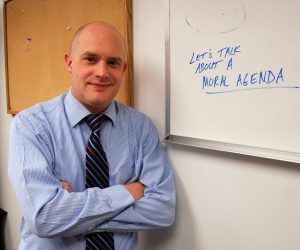
Anyway, after election day, Lowry erased the white marker board in his office at KDP headquarters in Frankfort. He grabbed a blue felt tip pen and wrote, “LET’S TALK ABOUT A MORAL AGENDA.”
The symbolism is hard to miss. Having wiped his slate clean, the Georgetown resident is ready for the KDP to start fresh.
So is Daniel Hurt, 23, one of the youngest members of the KDP Executive Committee. The western Kentuckian from Grand Rivers is all in for a Kentucky version of Moral Monday.
Hurt, who also chairs the Livingston County Democratic Executive Committee, points out that Moral Monday has deep roots in North Carolina’s faith community.
The movement’s leader is the Rev. William Barber, who is also president of the state NAACP.
“I am a member of a mainline Protestant church and I believe that you prove yourself through your actions,” said Hurt, a Methodist. “One of the best ways to do that is with public service, whether it’s in government or in the community. For example, you can advocate for universal health care and for social programs to help the less fortunate. These programs, these ideas, sure, are public policy areas, but they are appropriate ways of displaying your faith through action. People hear a lot of talk, but what is really important is that we put those words into actions.”
Meanwhile, there seems little the Democrats can do to stop the hard-right GOP juggernaut when the General Assembly convenes next month.
The Republicans hold a 27-11 Senate majority. Their House edge is 64-36. Thus, Lowry and Hurt concede that the Democrats’ comeback trail is likely to be rocky, steep and lengthy.
But a Moral Monday-like grassroots movement might be sprouting in Murray, where Hurt is a senior political science major at Murray State University.
A “March for Equality and Social Justice” is set for Jan. 21 to coincide with the Women’s March on Washington. Organizers include university faculty, students, union members, retirees, clergy and others.
The march, according to the group, “is a celebration of the principles of democracy, a demonstration of solidarity with the disenfranchised, and a demand of our government/leaders that they uphold the United States Constitution and be accountable to those principles of equality and justice for all.”
Berry Craig is the webmaster-editor for the Kentucky State AFL-CIO, and also services on the state AFL-CIO Executive Board and serves as recording secretary for the Paducah-based Western Kentucky AFL-CIO Area Council. He is a charter member of American Federation of Teachers Local 1360.
Dangerous immigrants loyal to an “inflated … despot” are endangering our country.
Determined to force their “false religion” and its “anti-Christian” law on America, these fanatical foreigners are “a foe to the very principles we embody in our laws, a foe to all we hold most dear.” They are “the chief source of crime in this country” to boot.
All that bigoted baloney might sound like a Donald Trump stump speech. But it’s stock Know-Nothing boilerplate from the 1850s.
The president-elect resurrected the hate and fear-mongering legacy of the Know-Nothings, a white, Protestant nativist party that made a big splash in my native Kentucky in the mid-19th century.
“Trump is using the same demagogic tactics,” said Duane Bolin, a Murray, Ky., State University historian and author. “The Know-Nothings appealed to nativism and fear, and Trump does that so well, too.”
The Know-Nothings were officially the American Party. Members were called “Know-Nothings” because they were supposed to reply — like Sgt. Schultz on “Hogan’s Heroes” — “I know nothing” to an inquiry about the party from a possibly hostile newspaper reporter or any suspicious stranger.
While neo-Know-Nothing Trump focuses his xenophobia on Muslims and Hispanics, Catholic German and Irish immigrants were the chief objects of Know-Nothing disaffection. Party members pledged “Eternal hostility to Foreign and Roman Catholic influence!”
The American Party swept Kentucky, my home state, on election day in 1855, when a nativist riot in Louisville left at least 19 men dead, according to the Kentucky Encyclopedia.
Know-Nothing mobs rampaged through German and Irish immigrant neighborhoods in the Falls City, murdering, beating, burning and looting. The violence went down in history as “Bloody Monday.”
Know-Nothings took control of city governments in Louisville, Lexington and Covington. The state elected a Know-Nothing governor, Charles S. Morehead. Know-Nothings captured both houses of the General Assembly and claimed six of the state’s 10 U.S. House seats, the encyclopedia says.
History, the subject I taught in a western Kentucky community college for two dozen years, records that seven other states elected Know-Nothing governors in 1855. Beyond Kentucky, 37 more Know-Nothings were elected to Congress, and five got U.S. Senate seats. Several mayors and dozens of city officials and state legislators belonged to the party.
Trump won nearly 63 percent of the Kentucky vote. He lost only two of the Bluegrass State’s 120 counties—Jefferson (Louisville) and Fayette (Lexington).
The immigrant-bashing Trump will become the country’s 19th Republican president. Kentucky-born Abraham Lincoln, the first Republican president, denounced Know-Nothing anti-immigrant bilge in no uncertain terms.
Trump is more proof, as if proof were needed, that the GOP of “Lincoln and Liberty, too,” is all but gone.
“I am not a Know-Nothing,” Abraham Lincoln declared in a famous 1855 letter to his friend, Joshua F. Speed of Louisville. “That is certain. How could I be?
“How can any one who abhors the oppression of Negroes, be in favor of degrading classes of white people? Our progress in degeneracy appears to me to be pretty rapid. As a nation, we begin by declaring that ‘all men are created equal.’”
The future Great Emancipator added, “We now practically read it ‘all men are created equal, except Negroes.’ When the Know-Nothings get control, it will read ‘all men are created equal, except Negroes, and foreigners, and Catholics.’ When it comes to this I should prefer emigrating to some country where they make no pretence of loving liberty-to Russia, for instance, where despotism can be taken pure, and without the base alloy of hypocrisy.”
Ultimately, the Know-Nothings faded away and ended up on the trash heap of history, where they belong. There’s plenty of room for Trump, a big fan of Vladimir Putin-ruled Russia, in history’s landfill, too.
Berry Craig is the webmaster-editor for the Kentucky State AFL-CIO, and also services on the state AFL-CIO Executive Board and serves as recording secretary for the Paducah-based Western Kentucky AFL-CIO Area Council. He is a charter member of American Federation of Teachers Local 1360.
History books say the Civil War effectively ended on April 9, 1865, when Robert E. Lee surrendered to Ulysses S. Grant at Appomattox Court House, Va.
“We’re fighting the last battle of the Civil War,” Rob Reiner said the other night on MSNBC’s “Hardball with Chris Matthews.”
The director, producer, “All in the Family” immortal and liberal political activist was speaking metaphorically of Donald Trump’s election.
Trump detractors, and at least one defender, have compared the president-elect to George Wallace, Alabama’s segregationist governor who carried five former Confederate states when he ran for president in 1968.
Trump, too, sounds like Democrat Franklin Pierce, who was elected president in 1852. Anti-slavery Republicans slammed Pierce, a New Hampshire Democrat, as a craven “Doughface,” a Northerner who happily carried water for the pro-slavery, white supremacist South.
Anyway, more than a few Confederate battle flags fluttered above Trump yard signs and flapped at Trump rallies in Dixie and in border states like Kentucky, where I was born, reared and still live.
Trump pandered to bigotry harder than any presidential hopeful since Wallace, who won a quintet of Kentucky counties 48 years ago: Bullitt, Christian, Fulton, Hickman and Todd. They went for Trump, as did all but two of the Bluegrass State’s 120 counties–Jefferson (Louisville) and Fayette (Lexington).
Trump “is a classic American scaremonger tapping into recurrent white American anxieties,” wroteSlate’s Jamelle Bouie. “And while Trump has borrowed his ‘silent majority’ rhetoric from Richard Nixon, the man he most resembles is that era’s id, a demagogue who fed on the fear and anxiety of the 1960s and ’70s—George Wallace.”
Bouie added that Wallace-like, Trump “is an eruption of the ugliest forces in American life, at turns authoritarian, like the Louisiana populist Huey Long, or outright fascistic, like the Second Ku Klux Klan. And like all of the above, he’s brought the background prejudice of American life to the forefront of our politics, and opened the door to even worse rhetoric and action.”
A Wallace ally and a Wallace daughter also detect parallels between Wallace and Trump.
“It’s just a replay,” Charlie Snider, one of Wallace’s most trusted political aides, said to NPR’s Debbie Elliott. “We’re looking at a modern-day George Wallace.”
Snider backed Trump. Before the election, NPR reported that Peggy Wallace Kennedy, who supported Trump’s opponent, Democrat Hillary Clinton, believed that Trump “is exploiting voters’ worst instincts, the way her late father once did. ‘They both were able to adopt the notion that fear and hate are the two greatest motivators of voters that feel alienated from government.'”
“It is very disturbing to think that the first African American president is followed by someone who is supported by the Ku Klux Klan,” Reiner said.
Pro-Trump “white nationalists” are “hanging on for dear life,” he added. They are “threatened by the idea that the country is moving away from them and is becoming more diverse.”
John Hennen, a retired Morehead, Ky., State University history professor, agrees with Reiner. So does David Nickell, a sociology and philosophy professor at West Kentucky Community and Technical College in Paducah, where I taught history for two dozen years.
Hennen said the Fourth Estate, for whatever reason, largely downplayed racism as a significant factor in Trump’s appeal to whites. “The media mostly papered over it. ‘Oh, no, no,’ they said. ‘His supporters are misunderstood, they’re desperate—they’re not racists.’”
Not all Trump voters are racists, Hennen acknowledged. “But the people who were really serious about correcting what is structurally wrong with the economy supported Bernie Sanders,” who Clinton bested for the Democratic presidential nomination.
Nickell said the Trump movement mainly was fueled by “a backlash against changing demographics and cultural trends in society at large.”
That backlash was racially-tinged, according to Nickell. He said that the birther movement, which Trump eagerly embraced and promoted–plus claims that President Barack Obama is a secret Muslim–were “ways of saying he is an ‘other,’ and not one of us.”
Hennen agreed that the racist roots of the Trump campaign go “all the way back to when he helped lead the crusade to prove that Obama was a foreigner.”
Hennen, Nickell and Reiner recognize that many Americans believed—or wanted to believe—that Obama’s election meant white America had shed its racist roots, that the country was post-racial.
“If anything, [the Trump campaign] brought out what had been an undercurrent of racism all along,” Nickell said. “It brought it back to the surface.”
Trump denies he is a racist. “I’ve never met anybody who admitted he was a racist,” Nickell said. “I don’t really care if he is a racist personally, but racist groups embraced him,” Hennen said.
An official Ku Klux Klan newspaper backed Trump. Ex-Klan leader David Duke, who is still a pro-Nazi white supremacist, supported Trump’s candidacy. Duke called Trump’s election “one of the most exciting nights of my life.”
The white supremacists are still whooping it up –some giving Nazi-style salutes–over Trump’s win, though Trump has said he rejects them, the Klan, Duke and the whole hatemongering “alt-right.”
After the election, Trump told a group of New York Times editors and reporters, “I don’t want to energize the [alt-right], and I disavow the group,” wroteThe Washington Post’s Olivia Nuzzi.
She added that “when Clinton delivered her speech about the alt-right in August, Trump responded not by disavowing the movement but by labeling her a bigot. And outside his post-election comments to the Times, Trump hasn’t specifically addressed the alt-right. He has never asked its members to stop photoshopping Jewish journalists into gas chambers in his honor.
“What’s more, he has often seemed to wink in their direction by deploying their rhetoric, with his talk of opposing ‘globalism,’ his repeated retweets of alt-right Twitter accounts and his use of imagery — such as a Star of David illustration — that originated on Nazi websites.”
Meanwhile, this retired reporter-turned-history prof is still hoping some TV talking head or newspaper scribe will yet ask Trump why he thinks so many racists–sexists, misogynists, anti-Semites and nativists, too–were attracted to his candidacy. If a journalist has popped that question, I missed it.
Berry Craig is the webmaster-editor for the Kentucky State AFL-CIO, and also services on the state AFL-CIO Executive Board and serves as recording secretary for the Paducah-based Western Kentucky AFL-CIO Area Council. He is a charter member of American Federation of Teachers Local 1360.
Kevin Wheatley of cn2 reported that Kentucky Democratic Party bigwigs did “a lot of soul-searching” at their election post-mortem in Frankfort Saturday.
Time will tell if the KDP Executive Committee and other party leaders find anything that might dull the Bluegrass State’s brighter-than-ever Republican Red hue.
Like most Kentuckians who belong to a union, I’m a Democrat. I’ve never missed an election since my first one in 1968, when I voted for Hubert H. Humphrey for president. I voted for every Democratic White House hopeful since, right through to Hillary Rodham Clinton.
I’ve never voted for a Republican at any level. Yep, I’m one of a vanishing breed in the Bluegrass State: a “yellow dog” Democrat.
I was born, reared and still live in Mayfield, about as far west as Kentucky goes. I belong to another endangered species: my politics lean decidedly left.
I am not a party insider; almost none of the party brass know me from Adam. I’m as far from KDP leadership as Mayfield is from Frankfort—261.4 miles, according to Google. But nobody is rooting harder for a Democratic comeback in Frankfort and Washington than I am.
Meanwhile, here’s a quote that might make KDP HQ a little less gloomy as the days shorten and the winter of our discontent approaches: “It is just at this point, when things look darkest for the Democrats, that you can count on the Republicans to do something that will save the day–that is, it will save the day for us.”
President Harry S. Truman said that in a speech in 1948, the year he was elected to his own term.
Anyway, I’m ready to wager that a lot of people who voted for Donald Trump will be sorry by the time the red buds bloom in Kentucky. I’m betting King Leer will prove to be the colossal fraud we tried to warn John and Jane Q Citizen that he is.
The country just might be awash in a tsunami of buyer’s remorse. Some of the flood might even inundate Kentucky, which he of the Tang-hued mane won “bigly.”
Besides smashing unions, Gov. Matt Bevin, Kentucky’s Trump, and his right-wing Republican legislature are all set to take a meat axe to public education and turn state government from a watchdog on behalf of workers, consumers and the environment, into a lapdog for polluters, sharpies and other well-heeled folks of “the public be damned” persuasion.
Kentuckians might not take kindly to any of that.
Anyway, HST also mused that “the Republicans think they have been so successful with their campaign of smears and character assassination that they have the Democrats on the run.”
Here’s where it really starts to get good: “We are getting a lot of suggestions to the effect that we ought to water down our platform and abandon parts of our program. These, my friends, are Trojan horse suggestions. I have been in politics for over 30 years, and I know what I am talking about, and I believe I know something about the business. One thing I am sure of: never, never throw away a winning program. This is so elementary that I suspect the people handing out this advice are not really well-wishers of the Democratic Party.”
Give ‘em Hell Harry was really on a roll: “Now, we can always rely on the Republicans to help us in an election year, but we can’t count on them to do the whole job for us. We have got to go out and do some of it ourselves, if we expect to win. The first rule in my book is that we have to stick by the liberal principles of the Democratic Party. We are not going to get anywhere by trimming or appeasing. And we don’t need to try it.”
He warned: “I’ve seen it happen time after time. When the Democratic candidate allows himself to be put on the defensive and starts apologizing for the New Deal and the Fair Deal, and says he really doesn’t believe in them, he is sure to lose. The people don’t want a phony Democrat. If it’s a choice between a genuine Republican, and a Republican in Democratic clothing, the people will choose the genuine article, every time; that is, they will take a Republican before they will a phony Democrat, and I don’t want any phony Democratic candidates in this campaign. [Italics mine].
No doubt if Truman were alive, he would take Trump to task for shamefully pandering to prejudice: racism, sexism, misogyny, nativism and religious bigotry. “There is another thing we must stand firm on,” Truman said. “That is our pledge on the issue of civil rights. No citizen of this great country ought to be discriminated against because of his race, religion, or national origin. That is the essence of the American ideal and the American Constitution.”
So here’s this rank-and-filer’s plea to the KDP powers-that-be: It’s time to resurrect the party of FDR, HST and Lyndon B. Johnson–and Alben Barkley, Carl Perkins, Ned Breathitt and Wilson Wyatt.
Okay, charge me with living in the past. I am a retired community college history prof who writes books about Kentucky history.
But I’m ready for the KDP to return to its liberal–there, I said it–roots.
I’m ready for the leaders of my party to shout from the rooftops that nothing has done more for working stiffs and the least among us than activist social democratic government — as mirrored in FDR’s New Deal, HST’s Fair Deal and LBJ’s Great Society—in tandem with strong, free trade unions.
It’s time for Democrats to brag on Democratic successes like:
–Social Security and Medicare. GOP claims that they’re going broke are baloney and just an excuse to privatize or get rid of both programs, which most Republicans have fought tooth-and-nail all along.
— laws that guarantee workers the right to have a union, that establish a minimum wage and that provide unemployment insurance and workers’ compensation. The Republicans claimed all such was “creeping communism” and undermined the “free enterprise system”—meaning free of unions and of government stepping in to protect us from those FDR called “the malefactors of great wealth.”
— laws that mandate equal pay for equal work, protect the environment and protect worker safety and health on the job– more “radical” stuff, according to the GOP. (“What is right has always been called radical by those with a stake in what is wrong,” said an old McGovern for president poster of mine.)
— laws that prevent discrimination based on race, age, gender and sexual orientation. The Republicans long ago surrendered to the Democrats their historic role as the party of Lincoln, liberty and civil rights. The GOP is, especially in Kentucky and states farther south, what the Democrats in Dixie and the borderland used to be: mostly the white folks’ party.
In short, FDR, HST, LBJ, The Veep, Perkins, Breathitt and Wyatt were my kind of Democrats–Democrats who had faith in the notion that “The legitimate object of government, is to do for a community of people, whatever they need to have done, but can not do, at all, or can not, so well do, for themselves.” The quote is often attributed to FDR, but Abraham Lincoln–he and FDR are my two favorite presidents–said it first.
Go ahead. Argue that Democrats who think like I do are unelectable beyond “liberal Louisville” and maybe parts of Lexington. (Jefferson and Fayette were the only counties that Clinton won.) But in Kentucky, Nov. 8 was more proof, as if proof were needed, that trying to out-Republican the Republicans, notably on the social issues, doesn’t work.
In another ’48 speech, Truman said, “Republicans approve of the American farmer, but they are willing to help him go broke. They stand four-square for the American home — but not for housing. They are strong for labor — but they are stronger for restricting labor’s rights. They favor a minimum wage — the smaller the minimum wage the better.
“They endorse educational opportunity for all — but they won’t spend money for teachers or for schools. They think modern medical care and hospitals are fine — for people who can afford them. They approve of Social Security benefits — so much so that they took them away from almost a million people….They consider electric power a great blessing — but only when the private power companies get their rake-off.
“They say TVA is wonderful — but we ought never to try it again….They think the American standard of living is a fine thing — so long as it doesn’t spread to all the people. And they admire the Government of the United States so much that they would like to buy it.
“Now, my friends, that is the Wall Street Republican way of life. But there is another way — there is another way — the Democratic way, the way of the Democratic Party.”
in 2018, I’d love to hear more Kentucky Democrats sound more like the Man from Missouri on the stump from Sassafras Ridge to the banks of the Big Sandy and from Covington to the Black Jack Jog. Think it won’t fly outside the Falls City and the capital of the Big Blue Nation? Why not give it a try anyway? After all, where has Republican Lite gotten the Democrats in our state?
Berry Craig is the webmaster-editor for the Kentucky State AFL-CIO, and also services on the state AFL-CIO Executive Board and serves as recording secretary for the Paducah-based Western Kentucky AFL-CIO Area Council. He is a charter member of American Federation of Teachers Local 1360.
By Greg Harris, on Mon Nov 14, 2016 at 10:26 AM ET
The opportunity for Donald Trump to espouse a vision for a largely post-partisan right-of-center new politics is his to claim. He is not ideological to his core, which can potentially be an asset. For Trump to truly succeed at unifying (most of) the nation, he must triangulate—i.e. prioritize an action agenda that seeks to solve our most pressing problems as a nation over a partisan agenda that takes sides and leads to ongoing policy stalemate.
Here are some ideas on how Trump can change business as usual in Washington and win the admiration of most Americans regardless of political affiliation:
Foreign Policy
As a primary candidate, Trump was actually the least hawkish of the GOP field (with the possible exception of Rand Paul). Trump’s critiques of the Iraq war, for example, were heartfelt as he espoused the most realistic albeit unorthodox (for Republicans) views on foreign policy, correctly faulting our military adventurism in Iraq as creating the conditions that gave rise to ISIS. Similarly, he challenged our targeting of dictators in Syria, Libya and Iraq as creating more human suffering and instability, not less.
A more humble policy where nation building is prioritized less, and aligning NATO-level with street-level intelligence is prioritized more, would create a more resourceful and targeted way to defeat not nations but, rather, nation-less terrorist cells.
Tax Reform
If Trump is sincere about cleansing Washington and serving the people over the powerful, there is no better place to start than tax reform. One key area is replacing the income tax with a national sales tax. Such reforms could be progressive by exempting the first $10,000 in worker earnings from payroll tax (as two-thirds of Americans pay more in payroll tax than income tax) and applying the VAT to financial transactions and capital gains (hence, not sparing the one percent who make most their income off stocks versus salary). It would also reduce waste by addressing the hundreds of billions in uncollected taxes in our current system, while drastically downsizing the scope of the IRS.
More exciting still, such tax reform would serve Trump’s stated priority of cleaning “the swamp” and cleansing democratic institutions hijacked by powerful interests and lobbyists that currently manipulate the tax code to the advantage of elites that pay for their services.
Infrastructure & Energy
Infrastructure is one area where Trump has signaled a willingness to go big, and there is no other area that spells more opportunity for our nation to remake our economy while making a middle class life a reality again for millions of “forgotten” Americans. His proposed $1 trillion would be sufficient to fund thousands of projects in queue to fix crumbling bridges and sewer systems, expand congested highways, bolster flood prevention, fix an antiquated energy grid, and so on. In light of estimates that with “every billion dollars that you spend on infrastructure, you create 18,000 to 25,000 jobs,” millions of new jobs would be created.
If President Trump complemented investment in transportation with a goal of energy independence, he should look to make wind a primary energy supplier for the East and West coast states, plains states (from Kansas to Texas following the wind corridor) and regions along the Great Lakes; similarly, solar power could be a primary energy source for our Western and Southwestern states, perhaps combined with investment in desalination technology and distribution channels to make California and Southwestern states less vulnerable to drought. These types of investments would be 21st century equivalents to Hoover Dam.
Furthermore, if Trump did like Eisenhower–who oversaw the construction of the modern highway system with the coming of the age of the automobile–and declared the coming of the age of advanced transit linking all of America by high speed rail and intra-linking communities by spokes that feed of that rail (street cars, etc.), we would surpass the high rail and transit networks of advanced European and Asian nations while opening up massive new economic opportunity for our nation (e.g. connecting the working poor to job centers).
These investments would help America largely run on its own energy sources. And it would also shift geopolitical power away from oppressive regimes that feed on oil money, and end our days spending trillions on wars fought over foreign oil. In so doing, Trump could really create an America First energy policy and foreign policy.
Healthcare
Unlike candidate Trump, President-elect Trump has signaled a willingness to maintain some key features of Obamacare—including allowing young adults to stay on their parents’ insurance policies, and prohibiting discrimination based on pre-existing conditions. Trump might also consider a reform proposed from John Kerry’s 2004 campaign and allow federal subsidy for catastrophic care, and lower the age for Medicare eligibility (paid for my lifting the payroll tax cap). Such action would stabilize and even lower health insurance premium costs. Additional proposals like allowing insurance company completion across state lines (hence, curbing regional monopolies) would also help to keep premiums on par with inflation. In this way, a conservative alternative to Obamacare would also be compassionate, efficient and effective.
Immigration Reform
Contrary to his campaign rhetoric, President-elect Trump has signaled that he would pursue a more refined focus on illegals that have committed crimes, versus illegals in general. Trump should go further by rewarding good behavior and – consistent with his law and order views – reward with amnesty those illegals that have paid taxes, committed no crimes and demonstrated through their actions that they are very much an asset to America. Such an approach would be well received by most Americans, and win over in particular the support of many Latinos.
Rewarding Work
America is a generous country that pretty much guarantees a pathway to success for those who take advantage of the free education that is offered them, stay out of trouble, and work hard. But government cannot cure personal and moral issues. What government can do, in targeted ways, is reward positive behavior like hard work and continuing education.
For example, Ronald Reagan conceived of the earned income tax credit as a means to reward work by supplementing modest wages. Trump can build on such policies by expanding the EIC. He can also support small businesses (like mine) that are the leading employers in our nation. Small business owners are especially good at vetting and cultivating reliable workers, and could offer such worker more hours and more income if we were to get some relief in areas like payroll tax (perhaps by waving the employer match for the first $5000 in income), which deeply cut against our bottom lines.
Social Issues
Stay moderate. Young liberal and conservative minded folks alike increasingly could care less if a Gay couple gets married. But they do care about issues like crushing student debt, or spending trillions on foreign wars while we cannot afford to repair our nation’s antiquated infrastructure, or adequately care for our heroic veterans. Trump can be a leading voice for criminal justice reforms (now strongly advocated by many conservatives, including the Koch Brothers), including more cost effective policies to deal with the drug epidemic, including expanding addiction and mental health treatment that costs far less than prison.
Should Trump forge a new conservatism that applies serious and cost effective solutions to the pressing issues in out time – from quelling military adventurism to building a 21st century infrastructure and energy policy that would create millions of new – he would ironically evolve from a divisive candidacy to a unifying presidency. Here’s hoping the President-elect defeats ideologically driven Washington gridlock by ruling from a radical, activist center that shuns partisanship in favor of progress.
By Jonathan Miller, on Mon Jul 25, 2016 at 7:05 PM ET
One of the major reasons I consider myself a “recovering politician” and write for a web-zine of the same name has been laid bare by the recent wikileaks of the Democratic National Committee (DNC) emails. There is a corruption to modern politics that too often allows a campaign system disproportionately funded by elites to therefore disproportionately do the bidding of elites—powerful industries, individuals and special interests. We see this when ketchup is declared a vegetable; when anyone can have access to any damn gun they want; when insurers can cherry pick who they insure; when banks can wreck an economy and then come out wealthier on the other side.
There is a small segment of society capable of funding expensive campaigns. And politicians (as I experienced as a City Council candidate) spend disproportionate amounts of time talking to the elites to in order to fund their campaigns, which can skew perspective and priorities. The consequences emerge from the local to the national. While there are no pure sinners or saints, here is my snapshot of the “good and bad” on how the wikileaks reflect on the major players in the 2016 presidential race:
Barack Obama – GOOD
President Obama built a campaign apparatus outside of the Democratic National Committee (DNC). His “Organize for America” (OFA) amounted to the most potent grassroots fundraising and organizing apparatus in political history. His instinct to go outside the Party establishment will look better and better over time. (Note: Howard Dean deserves major props for being first out the gate for “net-roots” fundraising that helped drive his 2004 presidential run.)
Hillary Clinton – BAD
The email scandal that has haunted Secretary Clinton is now given new credence. Indeed, it shows how vulnerable (hack-able) emails can be to outside interests. Clinton violated State Department (and Obama Administration policy) policy, plain and simple. And now we are reminded why such policies exist. When classified information is made vulnerable, America is made vulnerable.
Bernie Sanders – GOOD
Sen. Sanders was right to call out DNC bias. His concerns are now vindicated. Furthermore, his grassroots donor base (the famous $27 average contribution from everyday people) represented a good antidote to a two-party establishment system where big money too often correlates to big spoils for the very powerful, often at the expense of everyday people who struggle under today’s economic conditions.
Gary Johnson – GOOD
The Libertarian Party has its most exciting and proven presidential tickets in decades, led by former New Governor Gary Johnson and former Massachusetts Governor William Weld. In some ways, their candidacy is a preview of what next generation Republicanism might look like – fiscally conservative, socially liberal, and pro-science.
Donald Trump – GOOD & BAD
Donald Trump’s message, like it or not, will resonate all the more now. His message on trade deals that quash the little guy, his distance from Wall Street, among other themes, sets himself up to be the messenger for a system that is in need of an enema. Sadly, too many Trump supporters – spurred by Trump himself – have turned their scorn towards the little people who suffer under global arrangements and/or lawlessness. This especially holds true for third world populations that are today’s indentured servants, and immigrants or illegal immigrants fleeing deplorable economic conditions and or extreme drug violence that has overtaken many Central American communities. A message about a system stacked against the proverbial “little guy” is powerful; a message that in turn casts vulnerable people of color as the problem is contradictory and, well, simply cruel.
The Two Party System – BAD
The Republican establishment was utterly rejected by its base voters during the primaries. Trump was not “their” choice. The Democratic establishment was narrowly undermined by Sanders, and it now appears the DNC did what they could to keep him down. I know from personal experience from local politics that the two-party system perpetuates itself through a system of spoils and picking winners and losers. And this is spoiling democracy.
This is in many ways a scary election. The “people” are fed up, but the vehicles to express that anger are compromised. We know in the abstract of a “system” that is rigged at many levels. But legitimate anger is being harkened by dog whistles from one campaign, and a compromised candidate from the other. Let’s pray that both major candidates – Hillary and Donald – recognize this historic moment and respond to it in ways that provide a somewhat shell shocked electorate with real options and a new direction.


 Blog this!
 Never in a million years did I think I would be sitting behinds bars in a state prison interacting with some of Ohio’s notorious high profile murders, rapists, pedophiles, drug dealers, robbers, drug addicts, gang members, and snitches; but in 2012, that became a reality. A who’s who of individuals that you heard about on the news, read about in the papers or that T.V shows did reports about; they all seemed to have ended up in A.O.C.I. in protective custody.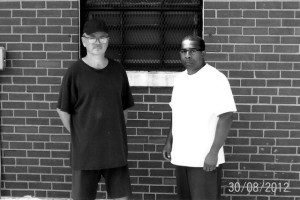

 Nobody from the Louisville Courier-Journal hoisted the Stars and Stripes ceremoniously at the old Jefferson County courthouse on Washington’s birthday.
 Anyway, after election day, Lowry erased the white marker board in his office at KDP headquarters in Frankfort. He grabbed a blue felt tip pen and wrote, “LET’S TALK ABOUT A MORAL AGENDA.”
 The opportunity for Donald Trump to espouse a vision for a largely post-partisan right-of-center new politics is his to claim. He is not ideological to his core, which can potentially be an asset. For Trump to truly succeed at unifying (most of) the nation, he must triangulate—i.e. prioritize an action agenda that seeks to solve our most pressing problems as a nation over a partisan agenda that takes sides and leads to ongoing policy stalemate.